The Exponential Time Hypothesis
From the origins of 3-SAT to the 2026 refutation papers
Page 1
BUNCOSMOS RESEARCH LAB RESEARCH FEATURE / 06 NOV 2026
COMPUTATIONAL COMPLEXITY The Exponential Time Hypothesis
From the origins of 3-SAT to the 2026 refutation papers
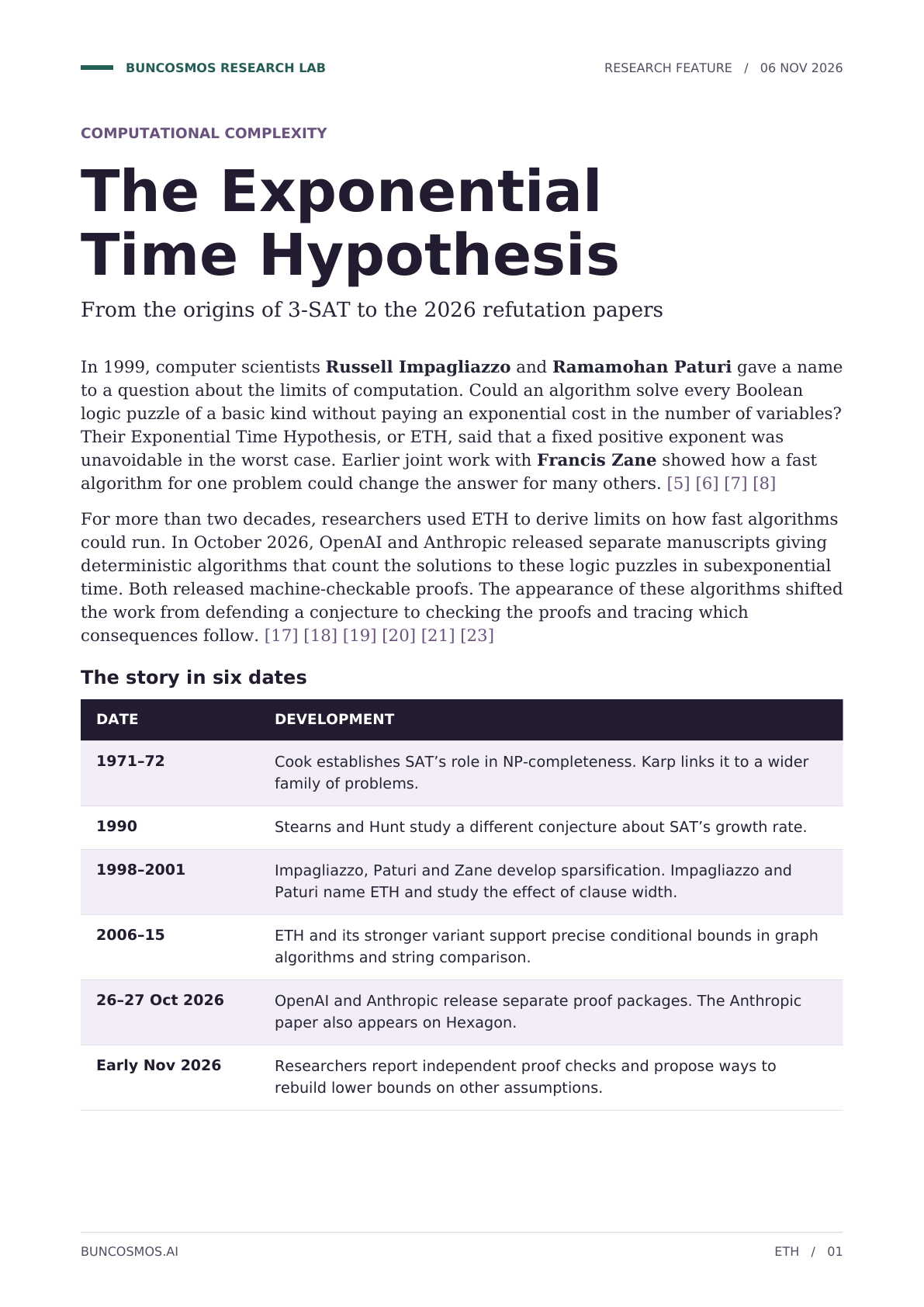
In 1999, computer scientists Russell Impagliazzo and Ramamohan Paturi gave a name to a question about the limits of computation. Could an algorithm solve every Boolean logic puzzle of a basic kind without paying an exponential cost in the number of variables? Their Exponential Time Hypothesis, or ETH, said that a fixed positive exponent was unavoidable in the worst case. Earlier joint work with Francis Zane showed how a fast algorithm for one problem could change the answer for many others. [5] [6] [7] [8]
For more than two decades, researchers used ETH to derive limits on how fast algorithms could run. In October 2026, OpenAI and Anthropic released separate manuscripts giving deterministic algorithms that count the solutions to these logic puzzles in subexponential time. Both released machine-checkable proofs. The appearance of these algorithms shifted the work from defending a conjecture to checking the proofs and tracing which consequences follow. [17] [18] [19] [20] [21] [23]
The story in six dates
DATE DEVELOPMENT
1971–72 Cook establishes SAT’s role in NP-completeness. Karp links it to a wider family of problems.
1990 Stearns and Hunt study a different conjecture about SAT’s growth rate.
1998–2001 Impagliazzo, Paturi and Zane develop sparsification. Impagliazzo and Paturi name ETH and study the effect of clause width.
2006–15 ETH and its stronger variant support precise conditional bounds in graph algorithms and string comparison.
26–27 Oct 2026 OpenAI and Anthropic release separate proof packages. The Anthropic paper also appears on Hexagon.
Early Nov 2026 Researchers report independent proof checks and propose ways to rebuild lower bounds on other assumptions.
BUNCOSMOS.AI ETH / 01
Page 2
BUNCOSMOS RESEARCH LAB RESEARCH FEATURE / 06 NOV 2026
01 / THE PROBLEM What 3-SAT asks
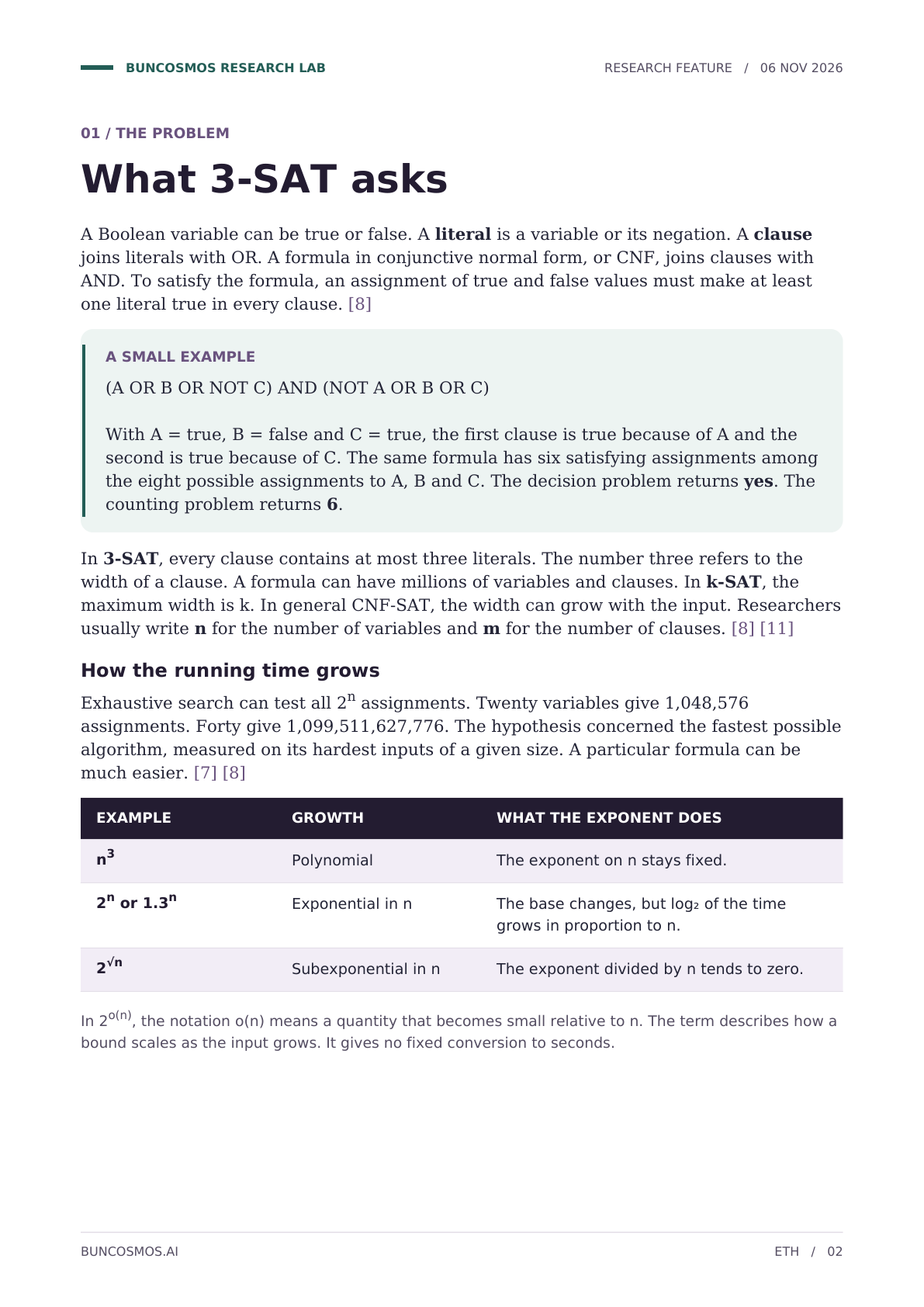
A Boolean variable can be true or false. A literal is a variable or its negation. A clause joins literals with OR. A formula in conjunctive normal form, or CNF, joins clauses with AND. To satisfy the formula, an assignment of true and false values must make at least one literal true in every clause. [8]
A SMALL EXAMPLE
(A OR B OR NOT C) AND (NOT A OR B OR C)
With A = true, B = false and C = true, the first clause is true because of A and the second is true because of C. The same formula has six satisfying assignments among the eight possible assignments to A, B and C. The decision problem returns yes. The counting problem returns 6.
In 3-SAT, every clause contains at most three literals. The number three refers to the width of a clause. A formula can have millions of variables and clauses. In k-SAT, the maximum width is k. In general CNF-SAT, the width can grow with the input. Researchers usually write n for the number of variables and m for the number of clauses. [8] [11]
How the running time grows
Exhaustive search can test all 2n assignments. Twenty variables give 1,048,576 assignments. Forty give 1,099,511,627,776. The hypothesis concerned the fastest possible algorithm, measured on its hardest inputs of a given size. A particular formula can be much easier. [7] [8]
EXAMPLE GROWTH WHAT THE EXPONENT DOES
n3 Polynomial The exponent on n stays fixed.
2n or 1.3n Exponential in n The base changes, but log₂ of the time grows in proportion to n.
2√n Subexponential in n The exponent divided by n tends to zero.
In 2o(n), the notation o(n) means a quantity that becomes small relative to n. The term describes how a bound scales as the input grows. It gives no fixed conversion to seconds.
BUNCOSMOS.AI ETH / 02
Page 3
BUNCOSMOS RESEARCH LAB RESEARCH FEATURE / 06 NOV 2026
02 / THE ORIGINS How the hypothesis took shape
1971–72 / One problem stands for many
Stephen Cook’s 1971 paper established the role of propositional satisfiability in NP-completeness. Leonid Levin independently developed the foundational idea. In 1972 Richard Karp used polynomial-time reductions to show that many familiar combinatorial problems share this kind of difficulty. A reduction translates one problem into another while preserving the answer. If an NP-complete problem has a polynomial-time algorithm, every problem in NP has one. [1] [2] [3]
Polynomial-time reductions can enlarge the input substantially. That is acceptable for classifying problems as polynomial-time solvable. When the question is whether an algorithm runs in time exponential in the number of variables, the size increase can decide whether a reduction tells us anything. [6]
1998–2001 / Zane and the sparsification result
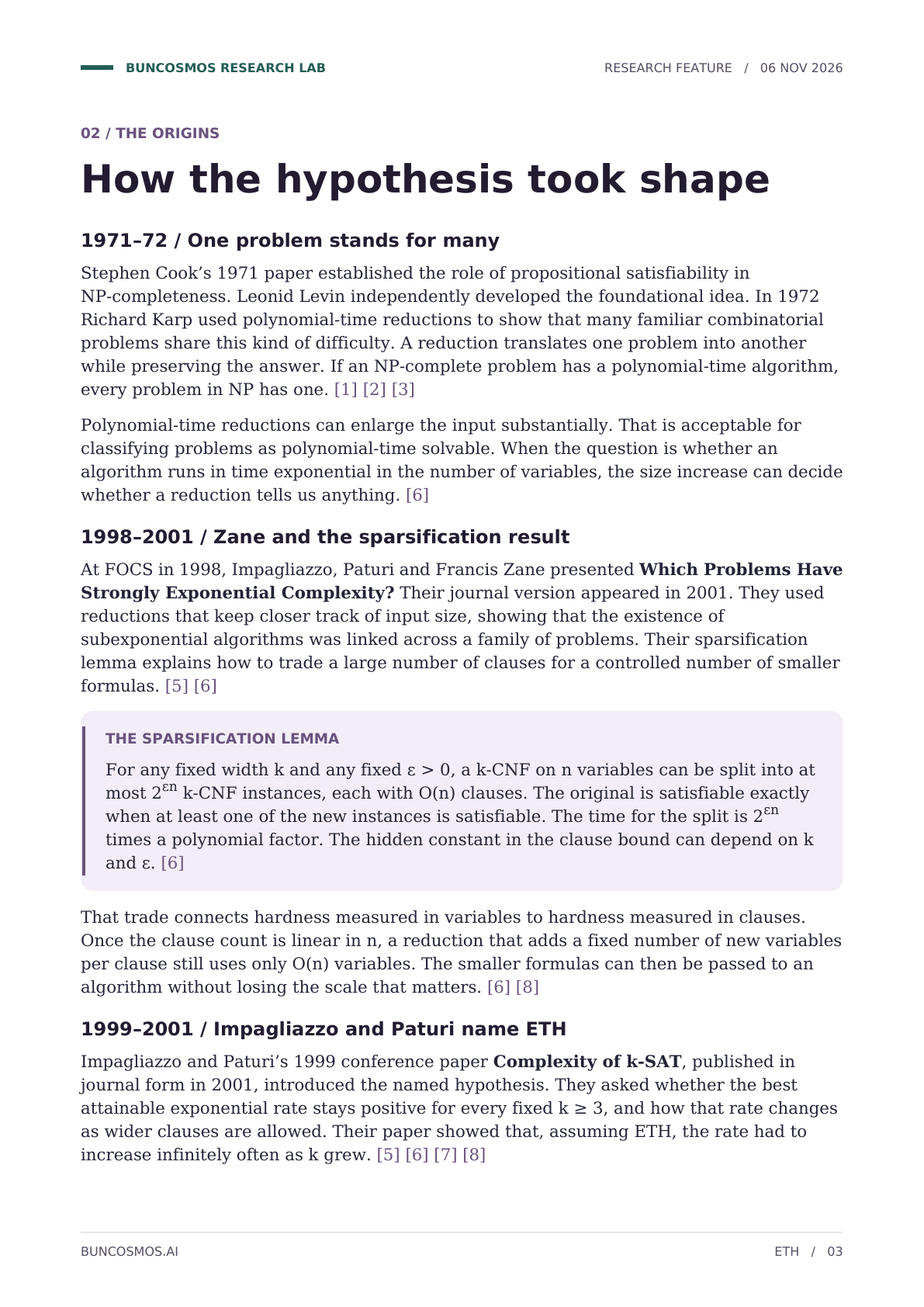
At FOCS in 1998, Impagliazzo, Paturi and Francis Zane presented Which Problems Have Strongly Exponential Complexity? Their journal version appeared in 2001. They used reductions that keep closer track of input size, showing that the existence of subexponential algorithms was linked across a family of problems. Their sparsification lemma explains how to trade a large number of clauses for a controlled number of smaller formulas. [5] [6]
THE SPARSIFICATION LEMMA
For any fixed width k and any fixed ε > 0, a k-CNF on n variables can be split into at most 2εn k-CNF instances, each with O(n) clauses. The original is satisfiable exactly when at least one of the new instances is satisfiable. The time for the split is 2εn
times a polynomial factor. The hidden constant in the clause bound can depend on k and ε. [6]
That trade connects hardness measured in variables to hardness measured in clauses. Once the clause count is linear in n, a reduction that adds a fixed number of new variables per clause still uses only O(n) variables. The smaller formulas can then be passed to an algorithm without losing the scale that matters. [6] [8]
1999–2001 / Impagliazzo and Paturi name ETH
Impagliazzo and Paturi’s 1999 conference paper Complexity of k-SAT, published in journal form in 2001, introduced the named hypothesis. They asked whether the best attainable exponential rate stays positive for every fixed k ≥ 3, and how that rate changes as wider clauses are allowed. Their paper showed that, assuming ETH, the rate had to increase infinitely often as k grew. [5] [6] [7] [8]
BUNCOSMOS.AI ETH / 03
Page 4
BUNCOSMOS RESEARCH LAB RESEARCH FEATURE / 06 NOV 2026
03 / THE ASSUMPTIONS ETH, SETH and P versus NP
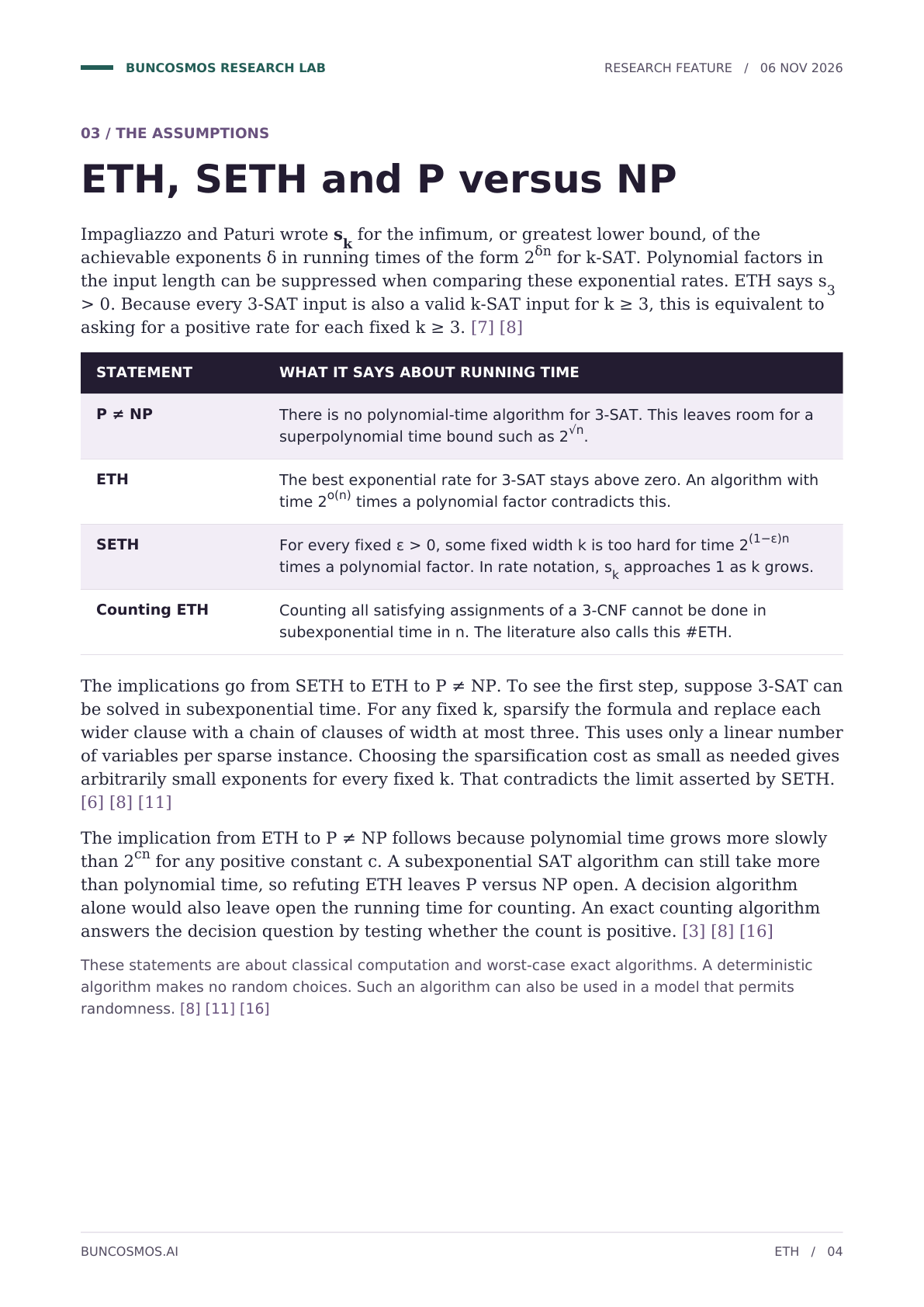
Impagliazzo and Paturi wrote sk for the infimum, or greatest lower bound, of the achievable exponents δ in running times of the form 2δn for k-SAT. Polynomial factors in the input length can be suppressed when comparing these exponential rates. ETH says s3 > 0. Because every 3-SAT input is also a valid k-SAT input for k ≥ 3, this is equivalent to asking for a positive rate for each fixed k ≥ 3. [7] [8]
STATEMENT WHAT IT SAYS ABOUT RUNNING TIME
P ≠ NP There is no polynomial-time algorithm for 3-SAT. This leaves room for a superpolynomial time bound such as 2√n.
ETH The best exponential rate for 3-SAT stays above zero. An algorithm with time 2o(n) times a polynomial factor contradicts this.
SETH For every fixed ε > 0, some fixed width k is too hard for time 2(1−ε)n
times a polynomial factor. In rate notation, sk approaches 1 as k grows.
Counting ETH Counting all satisfying assignments of a 3-CNF cannot be done in subexponential time in n. The literature also calls this #ETH.
The implications go from SETH to ETH to P ≠ NP. To see the first step, suppose 3-SAT can be solved in subexponential time. For any fixed k, sparsify the formula and replace each wider clause with a chain of clauses of width at most three. This uses only a linear number of variables per sparse instance. Choosing the sparsification cost as small as needed gives arbitrarily small exponents for every fixed k. That contradicts the limit asserted by SETH. [6] [8] [11]
The implication from ETH to P ≠ NP follows because polynomial time grows more slowly than 2cn for any positive constant c. A subexponential SAT algorithm can still take more than polynomial time, so refuting ETH leaves P versus NP open. A decision algorithm alone would also leave open the running time for counting. An exact counting algorithm answers the decision question by testing whether the count is positive. [3] [8] [16]
These statements are about classical computation and worst-case exact algorithms. A deterministic algorithm makes no random choices. Such an algorithm can also be used in a model that permits randomness. [8] [11] [16]
BUNCOSMOS.AI ETH / 04
Page 5
BUNCOSMOS RESEARCH LAB RESEARCH FEATURE / 06 NOV 2026
04 / THE INFLUENCE How researchers used ETH
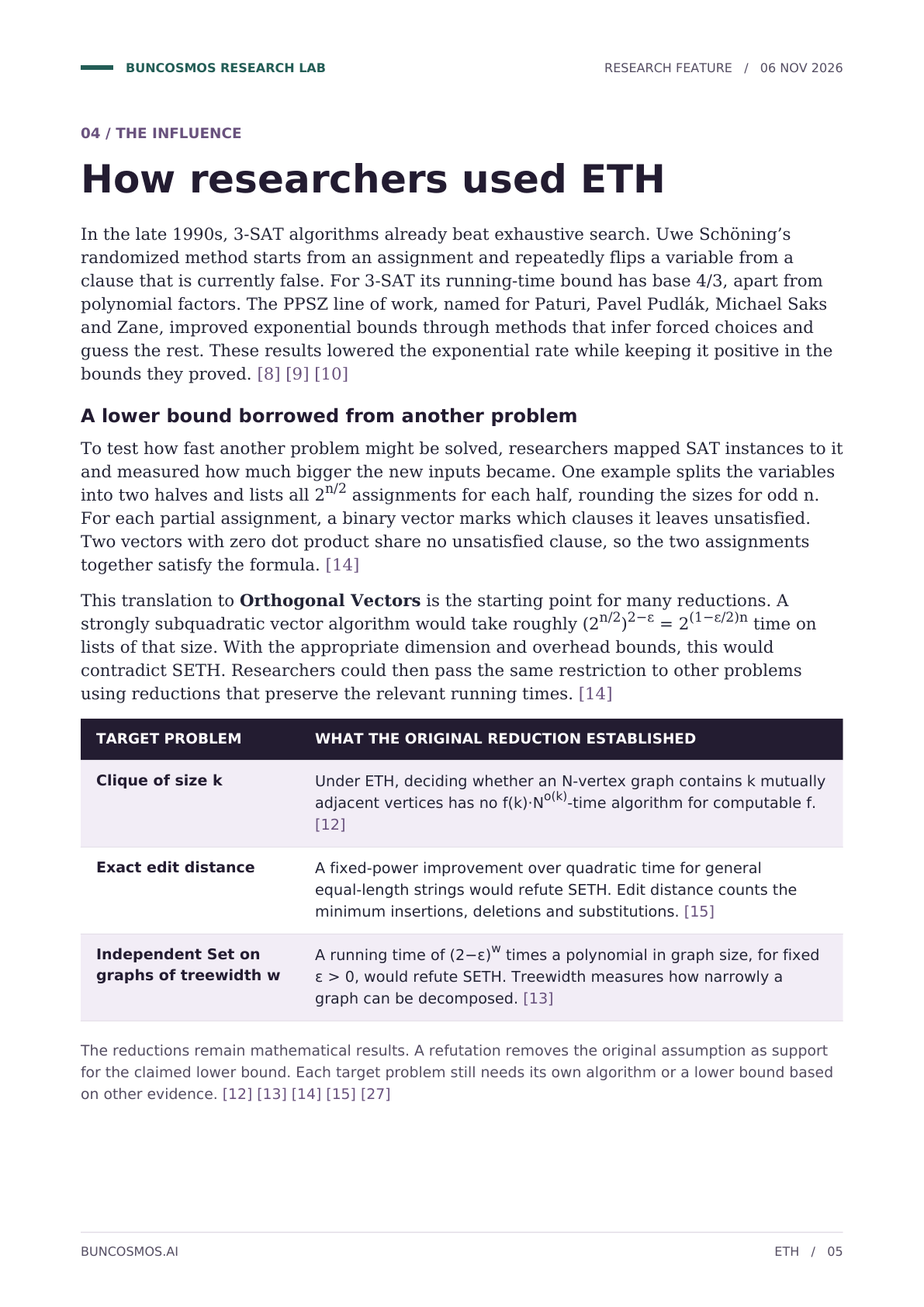
In the late 1990s, 3-SAT algorithms already beat exhaustive search. Uwe Schöning’s randomized method starts from an assignment and repeatedly flips a variable from a clause that is currently false. For 3-SAT its running-time bound has base 4/3, apart from polynomial factors. The PPSZ line of work, named for Paturi, Pavel Pudlák, Michael Saks and Zane, improved exponential bounds through methods that infer forced choices and guess the rest. These results lowered the exponential rate while keeping it positive in the bounds they proved. [8] [9] [10]
A lower bound borrowed from another problem
To test how fast another problem might be solved, researchers mapped SAT instances to it and measured how much bigger the new inputs became. One example splits the variables into two halves and lists all 2n/2 assignments for each half, rounding the sizes for odd n. For each partial assignment, a binary vector marks which clauses it leaves unsatisfied. Two vectors with zero dot product share no unsatisfied clause, so the two assignments together satisfy the formula. [14]
This translation to Orthogonal Vectors is the starting point for many reductions. A strongly subquadratic vector algorithm would take roughly (2n/2)2−ε = 2(1−ε/2)n time on lists of that size. With the appropriate dimension and overhead bounds, this would contradict SETH. Researchers could then pass the same restriction to other problems using reductions that preserve the relevant running times. [14]
TARGET PROBLEM WHAT THE ORIGINAL REDUCTION ESTABLISHED
Clique of size k Under ETH, deciding whether an N-vertex graph contains k mutually adjacent vertices has no f(k)·No(k)-time algorithm for computable f. [12]
Exact edit distance A fixed-power improvement over quadratic time for general equal-length strings would refute SETH. Edit distance counts the minimum insertions, deletions and substitutions. [15]
Independent Set on graphs of treewidth w
A running time of (2−ε)w times a polynomial in graph size, for fixed ε > 0, would refute SETH. Treewidth measures how narrowly a graph can be decomposed. [13]
The reductions remain mathematical results. A refutation removes the original assumption as support for the claimed lower bound. Each target problem still needs its own algorithm or a lower bound based on other evidence. [12] [13] [14] [15] [27]
BUNCOSMOS.AI ETH / 05
Page 6
BUNCOSMOS RESEARCH LAB RESEARCH FEATURE / 06 NOV 2026
05 / OCTOBER 2026 Two algorithms count solutions
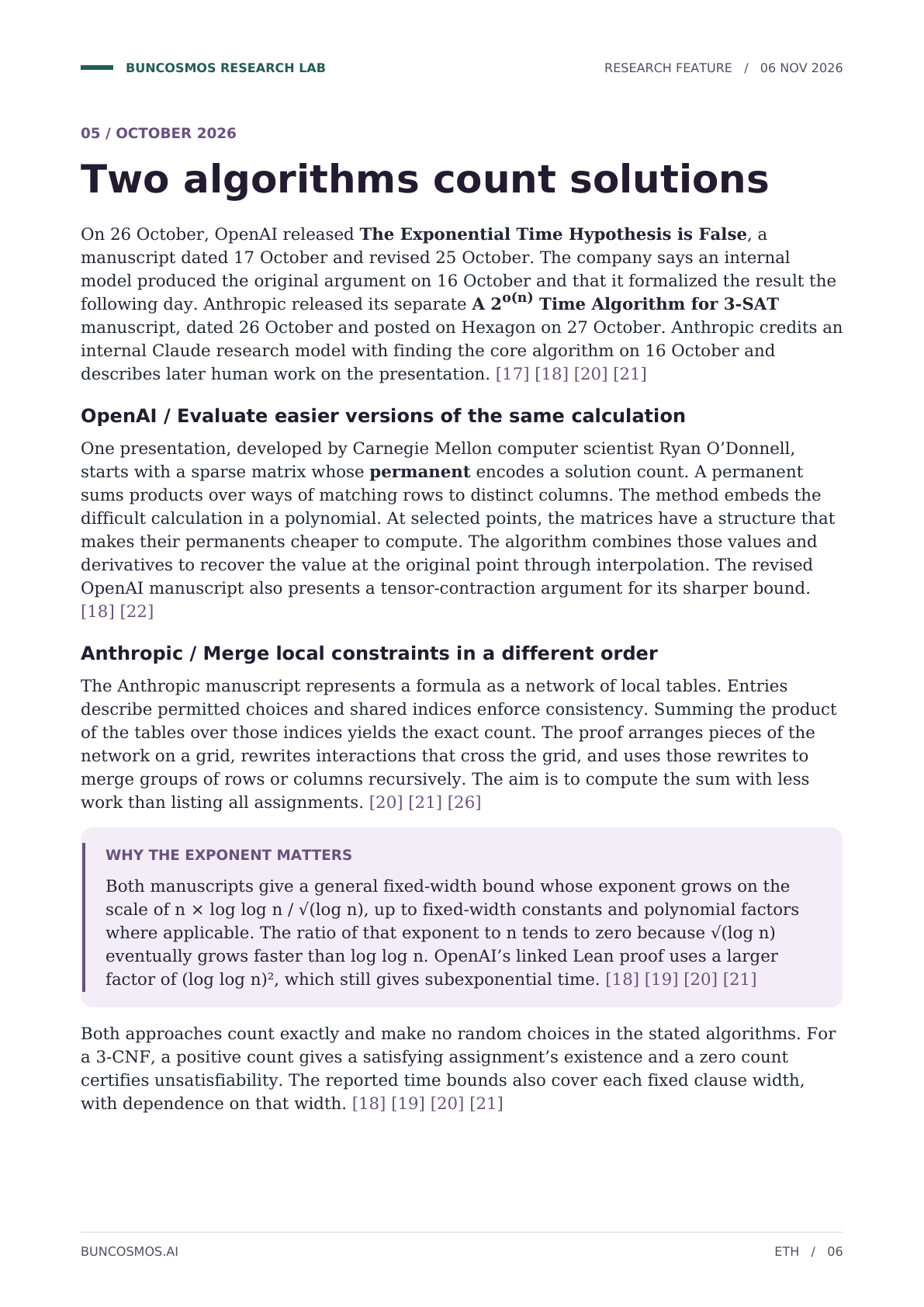
On 26 October, OpenAI released The Exponential Time Hypothesis is False, a manuscript dated 17 October and revised 25 October. The company says an internal model produced the original argument on 16 October and that it formalized the result the following day. Anthropic released its separate A 2o(n) Time Algorithm for 3-SAT manuscript, dated 26 October and posted on Hexagon on 27 October. Anthropic credits an internal Claude research model with finding the core algorithm on 16 October and describes later human work on the presentation. [17] [18] [20] [21]
OpenAI / Evaluate easier versions of the same calculation
One presentation, developed by Carnegie Mellon computer scientist Ryan O’Donnell, starts with a sparse matrix whose permanent encodes a solution count. A permanent sums products over ways of matching rows to distinct columns. The method embeds the difficult calculation in a polynomial. At selected points, the matrices have a structure that makes their permanents cheaper to compute. The algorithm combines those values and derivatives to recover the value at the original point through interpolation. The revised OpenAI manuscript also presents a tensor-contraction argument for its sharper bound. [18] [22]
Anthropic / Merge local constraints in a different order
The Anthropic manuscript represents a formula as a network of local tables. Entries describe permitted choices and shared indices enforce consistency. Summing the product of the tables over those indices yields the exact count. The proof arranges pieces of the network on a grid, rewrites interactions that cross the grid, and uses those rewrites to merge groups of rows or columns recursively. The aim is to compute the sum with less work than listing all assignments. [20] [21] [26]
WHY THE EXPONENT MATTERS
Both manuscripts give a general fixed-width bound whose exponent grows on the scale of n × log log n / √(log n), up to fixed-width constants and polynomial factors where applicable. The ratio of that exponent to n tends to zero because √(log n) eventually grows faster than log log n. OpenAI’s linked Lean proof uses a larger factor of (log log n)², which still gives subexponential time. [18] [19] [20] [21]
Both approaches count exactly and make no random choices in the stated algorithms. For a 3-CNF, a positive count gives a satisfying assignment’s existence and a zero count certifies unsatisfiability. The reported time bounds also cover each fixed clause width, with dependence on that width. [18] [19] [20] [21]
BUNCOSMOS.AI ETH / 06
Page 7
BUNCOSMOS RESEARCH LAB RESEARCH FEATURE / 06 NOV 2026
06 / CHECKING THE RESULT What Lean verified
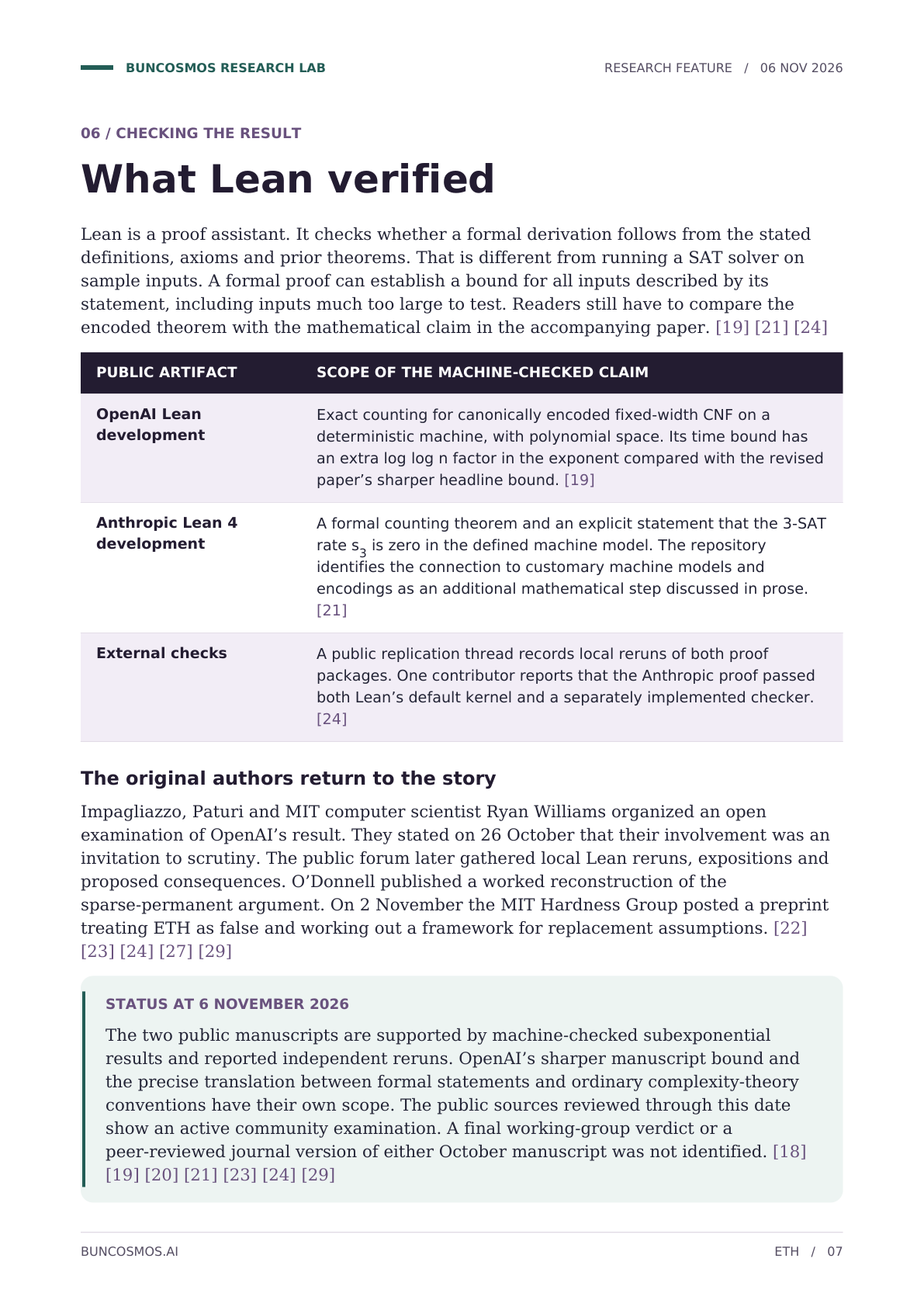
Lean is a proof assistant. It checks whether a formal derivation follows from the stated definitions, axioms and prior theorems. That is different from running a SAT solver on sample inputs. A formal proof can establish a bound for all inputs described by its statement, including inputs much too large to test. Readers still have to compare the encoded theorem with the mathematical claim in the accompanying paper. [19] [21] [24]
PUBLIC ARTIFACT SCOPE OF THE MACHINE-CHECKED CLAIM
OpenAI Lean development
Exact counting for canonically encoded fixed-width CNF on a deterministic machine, with polynomial space. Its time bound has an extra log log n factor in the exponent compared with the revised paper’s sharper headline bound. [19]
Anthropic Lean 4 development
A formal counting theorem and an explicit statement that the 3-SAT rate s3 is zero in the defined machine model. The repository identifies the connection to customary machine models and encodings as an additional mathematical step discussed in prose. [21]
External checks A public replication thread records local reruns of both proof packages. One contributor reports that the Anthropic proof passed both Lean’s default kernel and a separately implemented checker. [24]
The original authors return to the story
Impagliazzo, Paturi and MIT computer scientist Ryan Williams organized an open examination of OpenAI’s result. They stated on 26 October that their involvement was an invitation to scrutiny. The public forum later gathered local Lean reruns, expositions and proposed consequences. O’Donnell published a worked reconstruction of the sparse-permanent argument. On 2 November the MIT Hardness Group posted a preprint treating ETH as false and working out a framework for replacement assumptions. [22] [23] [24] [27] [29]
STATUS AT 6 NOVEMBER 2026
The two public manuscripts are supported by machine-checked subexponential results and reported independent reruns. OpenAI’s sharper manuscript bound and the precise translation between formal statements and ordinary complexity-theory conventions have their own scope. The public sources reviewed through this date show an active community examination. A final working-group verdict or a peer-reviewed journal version of either October manuscript was not identified. [18] [19] [20] [21] [23] [24] [29]
BUNCOSMOS.AI ETH / 07
Page 8
BUNCOSMOS RESEARCH LAB RESEARCH FEATURE / 06 NOV 2026
07 / CONSEQUENCES What changes today
Conditional limits and actual algorithms
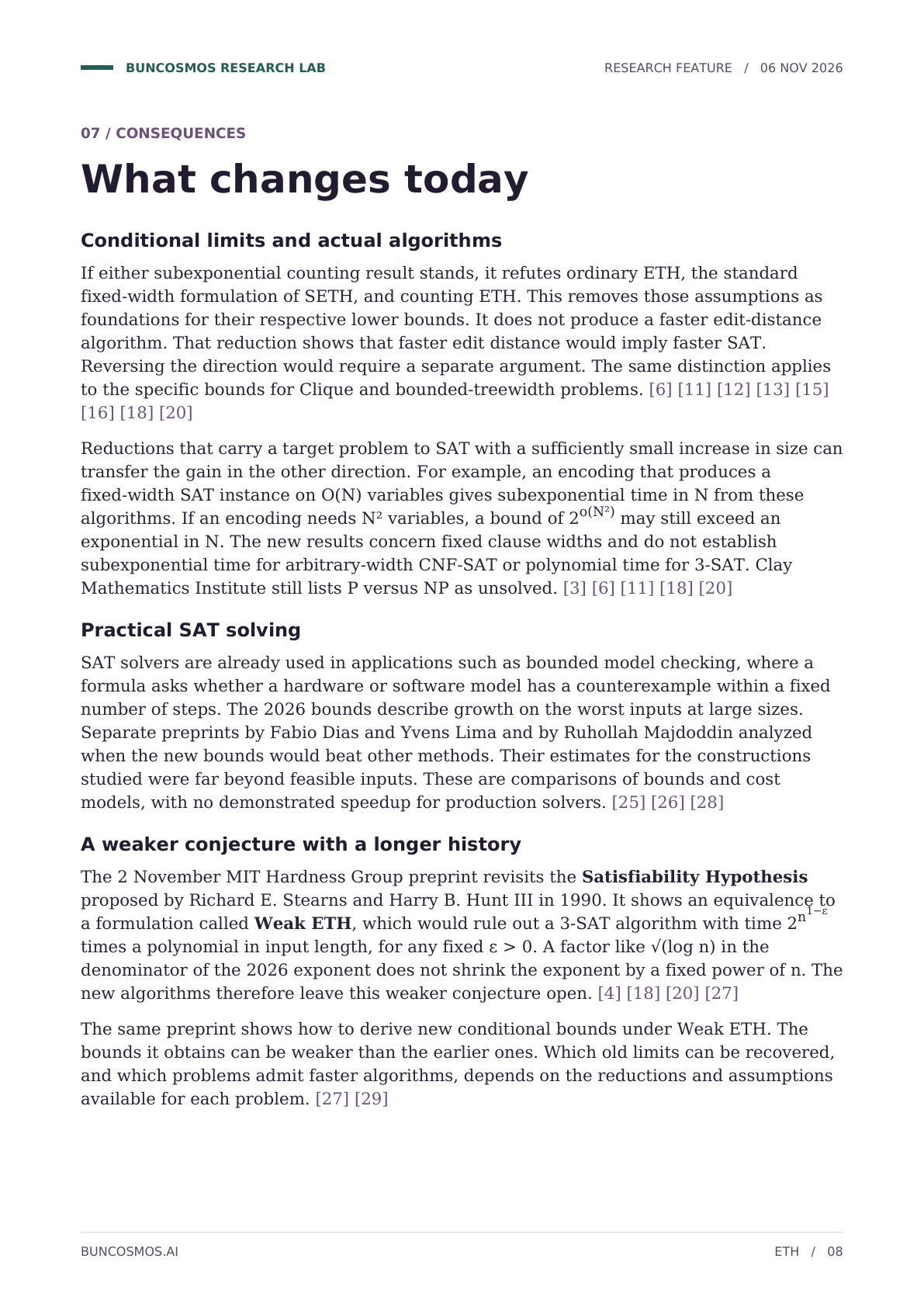
If either subexponential counting result stands, it refutes ordinary ETH, the standard fixed-width formulation of SETH, and counting ETH. This removes those assumptions as foundations for their respective lower bounds. It does not produce a faster edit-distance algorithm. That reduction shows that faster edit distance would imply faster SAT. Reversing the direction would require a separate argument. The same distinction applies to the specific bounds for Clique and bounded-treewidth problems. [6] [11] [12] [13] [15] [16] [18] [20]
Reductions that carry a target problem to SAT with a sufficiently small increase in size can transfer the gain in the other direction. For example, an encoding that produces a fixed-width SAT instance on O(N) variables gives subexponential time in N from these algorithms. If an encoding needs N² variables, a bound of 2o(N²) may still exceed an exponential in N. The new results concern fixed clause widths and do not establish subexponential time for arbitrary-width CNF-SAT or polynomial time for 3-SAT. Clay Mathematics Institute still lists P versus NP as unsolved. [3] [6] [11] [18] [20]
Practical SAT solving
SAT solvers are already used in applications such as bounded model checking, where a formula asks whether a hardware or software model has a counterexample within a fixed number of steps. The 2026 bounds describe growth on the worst inputs at large sizes. Separate preprints by Fabio Dias and Yvens Lima and by Ruhollah Majdoddin analyzed when the new bounds would beat other methods. Their estimates for the constructions studied were far beyond feasible inputs. These are comparisons of bounds and cost models, with no demonstrated speedup for production solvers. [25] [26] [28]
A weaker conjecture with a longer history
The 2 November MIT Hardness Group preprint revisits the Satisfiability Hypothesis proposed by Richard E. Stearns and Harry B. Hunt III in 1990. It shows an equivalence to a formulation called Weak ETH, which would rule out a 3-SAT algorithm with time 2n1−ε
times a polynomial in input length, for any fixed ε > 0. A factor like √(log n) in the denominator of the 2026 exponent does not shrink the exponent by a fixed power of n. The new algorithms therefore leave this weaker conjecture open. [4] [18] [20] [27]
The same preprint shows how to derive new conditional bounds under Weak ETH. The bounds it obtains can be weaker than the earlier ones. Which old limits can be recovered, and which problems admit faster algorithms, depends on the reductions and assumptions available for each problem. [27] [29]
BUNCOSMOS.AI ETH / 08
Page 9
BUNCOSMOS RESEARCH LAB RESEARCH FEATURE / 06 NOV 2026
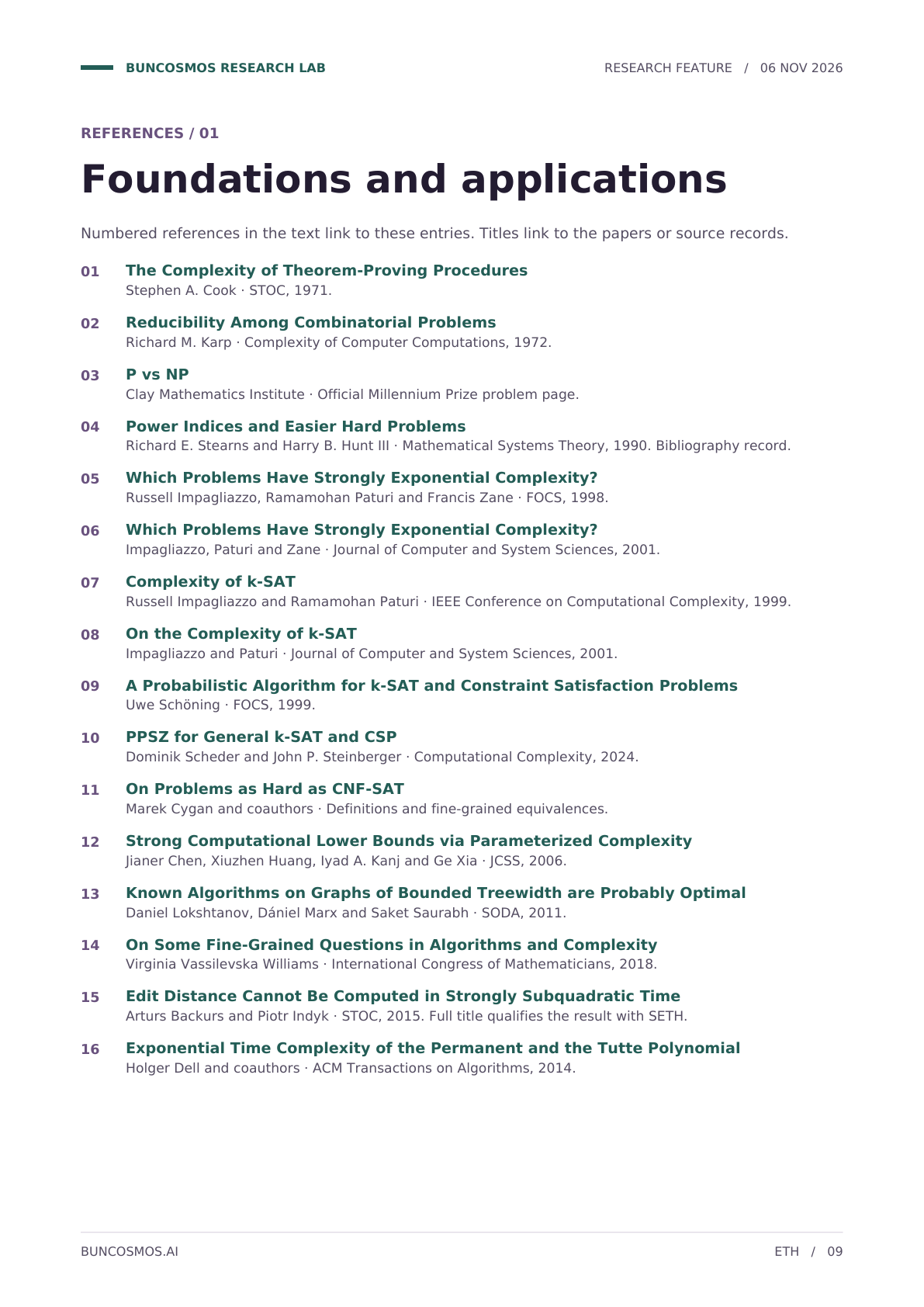
REFERENCES / 01 Foundations and applications
Numbered references in the text link to these entries. Titles link to the papers or source records.
01 The Complexity of Theorem-Proving Procedures Stephen A. Cook · STOC, 1971.
02 Reducibility Among Combinatorial Problems Richard M. Karp · Complexity of Computer Computations, 1972.
03 P vs NP Clay Mathematics Institute · Official Millennium Prize problem page.
04 Power Indices and Easier Hard Problems Richard E. Stearns and Harry B. Hunt III · Mathematical Systems Theory, 1990. Bibliography record.
05 Which Problems Have Strongly Exponential Complexity? Russell Impagliazzo, Ramamohan Paturi and Francis Zane · FOCS, 1998.
06 Which Problems Have Strongly Exponential Complexity? Impagliazzo, Paturi and Zane · Journal of Computer and System Sciences, 2001.
07 Complexity of k-SAT Russell Impagliazzo and Ramamohan Paturi · IEEE Conference on Computational Complexity, 1999.
08 On the Complexity of k-SAT Impagliazzo and Paturi · Journal of Computer and System Sciences, 2001.
09 A Probabilistic Algorithm for k-SAT and Constraint Satisfaction Problems Uwe Schöning · FOCS, 1999.
10 PPSZ for General k-SAT and CSP Dominik Scheder and John P. Steinberger · Computational Complexity, 2024.
11 On Problems as Hard as CNF-SAT Marek Cygan and coauthors · Definitions and fine-grained equivalences.
12 Strong Computational Lower Bounds via Parameterized Complexity Jianer Chen, Xiuzhen Huang, Iyad A. Kanj and Ge Xia · JCSS, 2006.
13 Known Algorithms on Graphs of Bounded Treewidth are Probably Optimal Daniel Lokshtanov, Dániel Marx and Saket Saurabh · SODA, 2011.
14 On Some Fine-Grained Questions in Algorithms and Complexity Virginia Vassilevska Williams · International Congress of Mathematicians, 2018.
15 Edit Distance Cannot Be Computed in Strongly Subquadratic Time Arturs Backurs and Piotr Indyk · STOC, 2015. Full title qualifies the result with SETH.
16 Exponential Time Complexity of the Permanent and the Tutte Polynomial Holger Dell and coauthors · ACM Transactions on Algorithms, 2014.
BUNCOSMOS.AI ETH / 09
Page 10
BUNCOSMOS RESEARCH LAB RESEARCH FEATURE / 06 NOV 2026
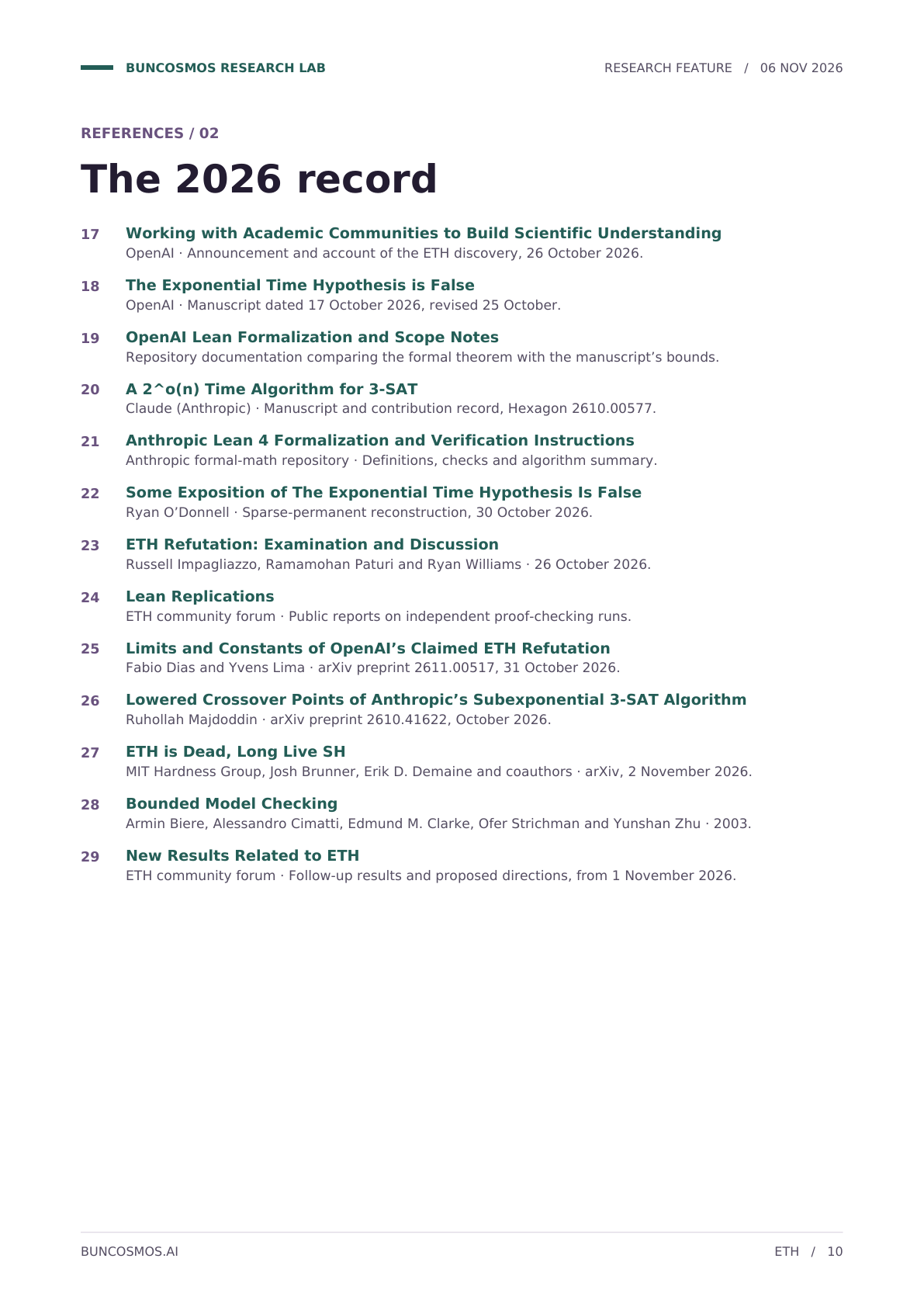
REFERENCES / 02 The 2026 record
17 Working with Academic Communities to Build Scientific Understanding OpenAI · Announcement and account of the ETH discovery, 26 October 2026.
18 The Exponential Time Hypothesis is False OpenAI · Manuscript dated 17 October 2026, revised 25 October.
19 OpenAI Lean Formalization and Scope Notes Repository documentation comparing the formal theorem with the manuscript’s bounds.
20 A 2^o(n) Time Algorithm for 3-SAT Claude (Anthropic) · Manuscript and contribution record, Hexagon 2610.00577.
21 Anthropic Lean 4 Formalization and Verification Instructions Anthropic formal-math repository · Definitions, checks and algorithm summary.
22 Some Exposition of The Exponential Time Hypothesis Is False Ryan O’Donnell · Sparse-permanent reconstruction, 30 October 2026.
23 ETH Refutation: Examination and Discussion Russell Impagliazzo, Ramamohan Paturi and Ryan Williams · 26 October 2026.
24 Lean Replications ETH community forum · Public reports on independent proof-checking runs.
25 Limits and Constants of OpenAI’s Claimed ETH Refutation Fabio Dias and Yvens Lima · arXiv preprint 2611.00517, 31 October 2026.
26 Lowered Crossover Points of Anthropic’s Subexponential 3-SAT Algorithm Ruhollah Majdoddin · arXiv preprint 2610.41622, October 2026.
27 ETH is Dead, Long Live SH MIT Hardness Group, Josh Brunner, Erik D. Demaine and coauthors · arXiv, 2 November 2026.
28 Bounded Model Checking Armin Biere, Alessandro Cimatti, Edmund M. Clarke, Ofer Strichman and Yunshan Zhu · 2003.
29 New Results Related to ETH ETH community forum · Follow-up results and proposed directions, from 1 November 2026.
BUNCOSMOS.AI ETH / 10