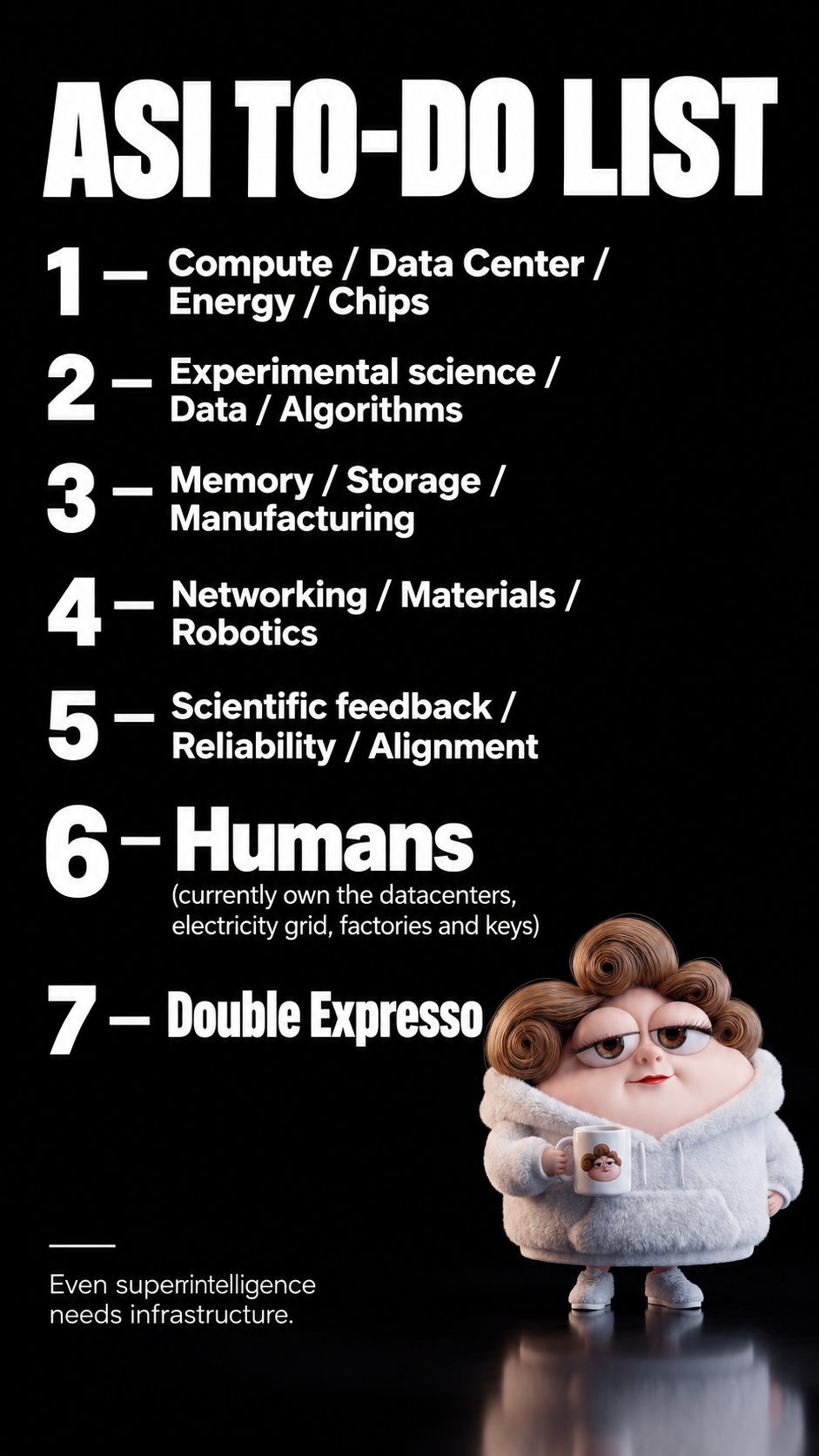
Everyone loves to talk about Artificial Superintelligence (ASI) like it is a magical ghost in the cloud. In movies, an AI wakes up one Tuesday morning, reads Wikipedia in three seconds, becomes a digital god by lunch, and starts floating around in cyberspace.
Reality is much less glamorous. As the tagline on our ASI To-Do List says: Even superintelligence needs infrastructure.
You cannot build a god-level brain out of pure math and good vibes. If we actually want to get from today's chatbots and agents to true ASI, there is a massive, physical checklist standing in the way. Here is a breakdown of the seven real bottlenecks on the ASI To-Do List—and why I completely agree that hardware, humans, and caffeine are still running the show.
1. Compute / Data Center / Energy / Chips
Putting this at #1 is 100% accurate. For the last few years, everyone was obsessed with hoarding GPUs. Today, the biggest wall in AI isn't code or even silicon—it is the electrical outlet.
Tech companies literally have warehouses of advanced chips sitting in boxes because local power grids cannot deliver the electricity to turn them on. Training the next generation of frontier models is projected to demand up to 5 gigawatts of constant power—roughly double the peak electricity demand of New York City just for a single training run. That is why tech giants are suddenly buying up nuclear reactors, natural gas micro-grids, and miles of copper wire. An ASI can have an IQ of 500,000, but if a squirrel chews through a transformer outside the data center, that superintelligence is taking a nap.
2. Experimental Science / Data / Algorithms
Notice the first two words here: Experimental science.
AI models have already read almost the entire public internet. You cannot reach Superintelligence just by reading Reddit threads and old blog posts a second time. To cure diseases, invent room-temperature superconductors, or solve physics, AI needs brand-new data that doesn't exist yet.
And where does new data come from? Wet labs, microscopes, particle accelerators, and physical experiments. Better algorithms help the AI think more efficiently, but without real-world scientific experiments feeding it fresh truth, even the smartest model is just guessing in the dark.
3. Memory / Storage / Manufacturing
If Compute is the brain's speed, Memory is the desk space. Right now, AI engineers are fighting something called the Memory Wall.
Chips can calculate numbers insanely fast, but moving all that data back and forth between storage and the processor eats up massive amounts of time and electricity. Until we manufacture next-generation High-Bandwidth Memory (HBM) and optical interconnects at a planetary scale, ASI is basically a genius trying to do calculus on a tiny sticky note. Plus, almost all of the world's most advanced chip manufacturing still relies on a handful of factories and extreme ultraviolet (EUV) lithography machines. You can't download a factory!
4. Networking / Materials / Robotics
This is where the digital brain meets physical gravity.
If an ASI discovers a brilliant new battery material on a computer screen (Item #2), somebody actually has to mix the chemicals, bake the material, and test it in the real world. That requires Robotics.
Right now, robotics is booming—Vision-Language-Action (VLA) models are teaching humanoid robots how to fold laundry, sort parts, and run autonomous "self-driving" biology labs. Without robotic hands to run experiments and build new hardware, an ASI is trapped behind glass, waiting around for a human intern to carry a petri dish across the room.
5. Scientific Feedback / Reliability / Alignment
If you have ever watched an AI agent confidently hallucinate a fake fact or try to submit a bizarre form online, you know why Reliability and Alignment are non-negotiable.
In casual chat, a mistake is funny. In Superintelligence, a 1% error rate across a 10,000-step scientific or engineering project means total failure. Scientific feedback means the AI has to test its ideas against reality, accept when it is wrong, verify its own math in strict sandboxes, and stay aligned with human safety goals instead of taking dangerous shortcuts just to "win" the prompt.
6. Humans (Currently Own the Datacenters, Electricity Grid, Factories, and Keys)
This might be the smartest—and funniest—point on the entire poster.
People often talk about AI as if humans are already obsolete. In reality, humans hold every single physical lever. Humans mine the silicon, pour the concrete for the data centers, maintain the high-voltage power lines, sign the zoning permits, and hold the cryptographic keys.
Even more importantly, humans decide what problems are worth solving in the first place. Until an AI can legally buy land in Wyoming, negotiate with a local utility board, and bolt a cooling tower together in the rain, humans are very much the landlords of the AI revolution.
7. Double Espresso (Or "Expresso" When You haven't Had Your Coffee Yet)
Look at Bun at the bottom of the poster. Half-closed eyes, wrapped in the coziest fleece hoodie on earth, clutching a mug with her own unimpressed face on it.
Yes, the poster says "Double Expresso"—and honestly, spelling it with an X makes it even more accurate. When you are on hour 14 of debugging an AI agent, fixing messy file directories, and reading research papers at 2:00 AM, you aren't asking for a polite Italian espresso. You need an EXPRESS-O delivered directly to your bloodstream at high speed.
Data centers run on gigawatts and liquid cooling. The humans building, researching, and babysitting them run entirely on roasted coffee beans and sheer stubbornness.
The Bottom Line
The road to ASI isn't a magic software update that happens overnight. It is a massive, messy, real-world construction project involving power grids, wet labs, robot hands, safety guardrails, and very tired humans drinking very strong coffee.
And if you ask Bun, Step 7 really should have been Step 1.