BUNCOSMOS / RESEARCH BRIEF
China AI
Developments
18–24 October 2026
A bilingual evidence review of models, agents, robotics, policy, scientific applications and creative AI
Prepared for BunCosmos
Research cutoff: 24 October 2026
Primary-source links, separate event and publication dates, claim provenance, coverage discrepancies and a ranked research agenda
Contents
Page numbers are cached estimates; Word or WPS can refresh the field on opening.
Executive Summary 3
Scope, Method and Evidence Rules 5
Research window and inclusion threshold 7
How claims are classified 7
The Week at a Glance 7
Five Developments Most Worth BunCosmos Following 9
1. Model Launches and Major Updates 11
1.1 MiniMax M3.1 Flash: low-cost agents meet a calibration problem 13
1.2 Kimi K3.1 Pro: a broad agent launch whose open-weight test is still ahead 13
1.3 iFlytek Spark X2.6: domestic compute and cloud–device routing 13
2. Chinese AI Agents and Agent Platforms 13
2.1 Qwen Go “My Apps”: persistent applications rather than disposable demos 15
2.2 CAICT’s agent evaluation: useful standardization, but not a ranking 15
3. Robotics and Embodied AI 15
3.1 Agibot Physical Reasoning: decision-focused real-robot data 17
3.2 Genie Studio 2.0: the operations layer behind robot deployment 17
3.3 FAW: industrial VLA demonstrations with explicit validation limits 17
4. Policy, R&D and Deployment Infrastructure 17
4.1 Beijing’s disruptive-AI call: specific technical directions, not new regulation 19
4.2 CAICT token-service monitoring: a more complicated inference economy 19
5. Research Papers and Scientific Uses of AI 19
5.1 No dominant peer-reviewed Chinese AI paper was verified in the exact window 21
5.2 National Energy Group: an applied catalyst-research case, published after the event 21
5.3 Yidu Tech’s TCM evidence agent: traceability without clinical validation 21
6. Creative AI: Image, Video and 3D Generation 21
6.1 Seedance 2.5 4K: a production workflow, with restricted access 23
6.2 Kimi’s 3D Make: creative AI inside an agent workflow 23
7. Named-Company Coverage Ledger 23
8. Source Comparison and Reporting-Risk Log 25
9. Publication-Worthy Research Agenda 27
What Western AI Coverage May Be Missing 29
Research cutoff: 24 October 2026
Geographic scope: AI developments in China, including Chinese organizations publishing in English
Editorial purpose: Identify publication-worthy developments, not simply repeat launch headlines
Executive Summary
The week’s most important story was not a single “best model” claim. It was the simultaneous movement of Chinese AI systems into several deployment layers: Moonshot and MiniMax shipped new agent-oriented models; Alibaba tested persistent, data-storing applications generated by consumers; Agibot released decision-focused robot data and an operations platform; and CAICT published evidence that token-service economics and serving quality are becoming more complicated as usage scales. These developments collectively suggest a shift from model demonstrations toward the infrastructure, operating economics, and workflow integration needed to make agents useful. The strongest independent result found this week was Artificial Analysis’s evaluation of MiniMax M3.1 Flash, which showed substantial capability and cost improvements but also poor calibration on factual questions (VentureBeat).
For BunCosmos, the five developments most worth following are MiniMax M3.1 Flash, Kimi K3.1 Pro, Qwen Go “My Apps,” Agibot’s Physical Reasoning dataset, and CAICT’s token-service monitoring report. Kimi and MiniMax matter because they combine ambitious agent capabilities with different openness and reliability questions. Qwen Go matters because generated applications can retain data and be shared, making them more than disposable web demos. Agibot matters because its dataset targets decision complexity rather than only manipulation skill. CAICT matters because its monitoring complicates the popular assumption that Chinese inference simply becomes cheaper and faster in every respect. Seedance 2.5 4K, iFlytek Spark X2.6, Genie Studio 2.0, Beijing’s disruptive-AI project call, and FAW’s industrial robots are also credible follow-up topics, but each has a narrower evidence base or more restricted availability.
The reporting itself is part of the story. Chinese launch coverage generally emphasized capability, customer cases, and national technological capacity; English coverage of MiniMax gave unusual prominence to independently measured hallucination behavior, while English searches returned little or no contemporaneous coverage of Qwen Go, Genie Studio 2.0, Beijing’s R&D call, or iFlytek’s cloud–device architecture. Date handling also requires care: Kimi’s launch appears as 23 October in UTC-oriented coverage and 24 October in Chinese reporting; CAICT’s agent results were presented on 14 October but published online on 20 October; and Shenzhen’s AI action plan, originally issued on 4 September, was recycled through a 23 October republication. These are not cosmetic discrepancies. They determine whether something is actually a development from this week.
Scope, Method and Evidence Rules
Research window and inclusion threshold
The core window is 18–24 October 2026, using the event date rather than the date on which an article happened to be indexed. An item could enter the main review if a meaningful release, launch, limited trial, policy call, exhibition demonstration, or report publication occurred inside that window. Items with an in-window publication but an earlier underlying event are labeled separately. DeepSeek-V4.1-Flash-1017, released on 17 October, is therefore used only as comparative context, while the CAICT agent evaluation is treated as an in-window publication of results announced on 14 October (CAICT). This distinction prevents a weekly report from becoming a collection of whatever search engines most recently surfaced.
The search process covered Chinese- and English-language queries across model launches, agent platforms, embodied AI, policy, scientific applications, and creative AI. Named-company searches included Moonshot/Kimi, DeepSeek, Alibaba/Qwen, ByteDance/Volcengine, Tencent, Baidu, MiniMax, Zhipu, Kuaishou/Kling, iFlytek, Agibot, FAW, Yidu Tech, and National Energy Group. Priority went to official blogs, government pages, model or dataset repositories, state media, and established technology publications. Search-result snippets were used as leads, not as sufficient evidence when a primary page could be opened. Where no significant in-window development was verified for a named company, the report says so rather than filling the gap with an older announcement.
How claims are classified
Each material claim is treated as one of four types. Primary-verified release facts include dates, availability, model identifiers, repository contents, prices, license text, and policy deadlines found on official pages. Vendor-reported results include benchmark scores, speedups, customer cases, productivity gains, deployment counts, and superiority claims supplied by the developer or its customers. Independent results require an evaluator outside the vendor; Artificial Analysis’s MiniMax measurements are the clearest example in this review. Analytical inferences are this report’s interpretations of why a development matters and should not be confused with demonstrated outcomes. This taxonomy is especially important for robotics, where a dataset, a demonstration, a production validation, and a scaled deployment are four different things.
Availability is also graded explicitly. “Available” means users could access the relevant product or repository during the window; “invitation test” and “selected enterprise trial” are not converted into general availability; and “promised” is not converted into “released.” Thus Kimi K3.1 Pro was available in hosted products while its full weights remained a commitment for 4 November, MiniMax’s weights were actually posted on 23 October, Qwen Go’s “My Apps” remained in invitation testing, and Seedance 2.5 4K was limited to some enterprise customers (Moonshot AI, MiniMax, China Economic Net, Phoenix Tech).
The Week at a Glance
Development | Event date | Publication date | What changed | Evidence and caution |
|---|---|---|---|---|
23 Oct UTC / 24 Oct China | Official blog 23 Oct; Chinese reports 24 Oct | Hosted launch of a 3T-class, 1M-context agent model plus Highspeed variant and 3D Make | Benchmarks and 2–3× speed claim are vendor-reported; full weights were only promised by 4 Nov | |
Hosted launch 19 Oct; weights 23 Oct | 19 Oct and 23 Oct respectively | 428B/23B-active MoE model for coding and agents; API and downloadable weights | Independent capability/cost gains coexist with poor factual calibration; community license is not permissive open source | |
23 Oct | 23 Oct | Natural-language apps with databases, deployment, sharing and persistent data | Invitation-only; examples are product demonstrations, not independent reliability tests | |
22 Oct | 22–23 Oct | Domestic-compute cloud–device model with a 4B endpoint and task-based routing | Training, inference and routing gains are launch-event claims | |
22 Oct | 22 Oct | Fourth AGIBOT WORLD 2026 release, linking decisions, task states and physical actions | Research resource, not evidence of general robot competence; CC BY-NC-SA 4.0 restricts commercial use | |
23 Oct | 23 Oct | Combined model iteration, visual workflow orchestration and multi-robot monitoring | Seven-day deployment and customer metrics are company cases, not generalized benchmarks | |
Exhibition 21–24 Oct | 22 Oct | Heavy-load and upgraded dual-arm wheel robots with VLA-based operation | Heavy robot remains in test validation; no independent uptime or safety results | |
23 Oct | 23 Oct | R&D call for AI-native chips, non-Transformer architectures and self-improving frontier models | A funding call, not a new AI regulation or completed technical advance | |
Monitoring Jan–Aug 2026 | 23 Oct | Cross-provider evidence on token use, prices, TPS, latency and context availability | Some headline usage figures were already public; value lies in the combined monitoring analysis | |
Results presented 14 Oct | 20 Oct | Updated cumulative list spanning 74 product evaluations and more than 70 organizations | Passing an evaluation is not a league-table ranking; the event predates the strict window | |
23 Oct | 23 Oct | 4K/10-bit version with 480p Draft workflow and improved reference consistency claims | Selected enterprise trial only; quality and customer assessments are not independent comparisons | |
21 Oct | 21 Oct | Evidence-tracing assistant for classical texts, guidelines, terminology and prescriptions | Deployment and knowledge-base figures are company-reported; no clinical-outcome validation found |
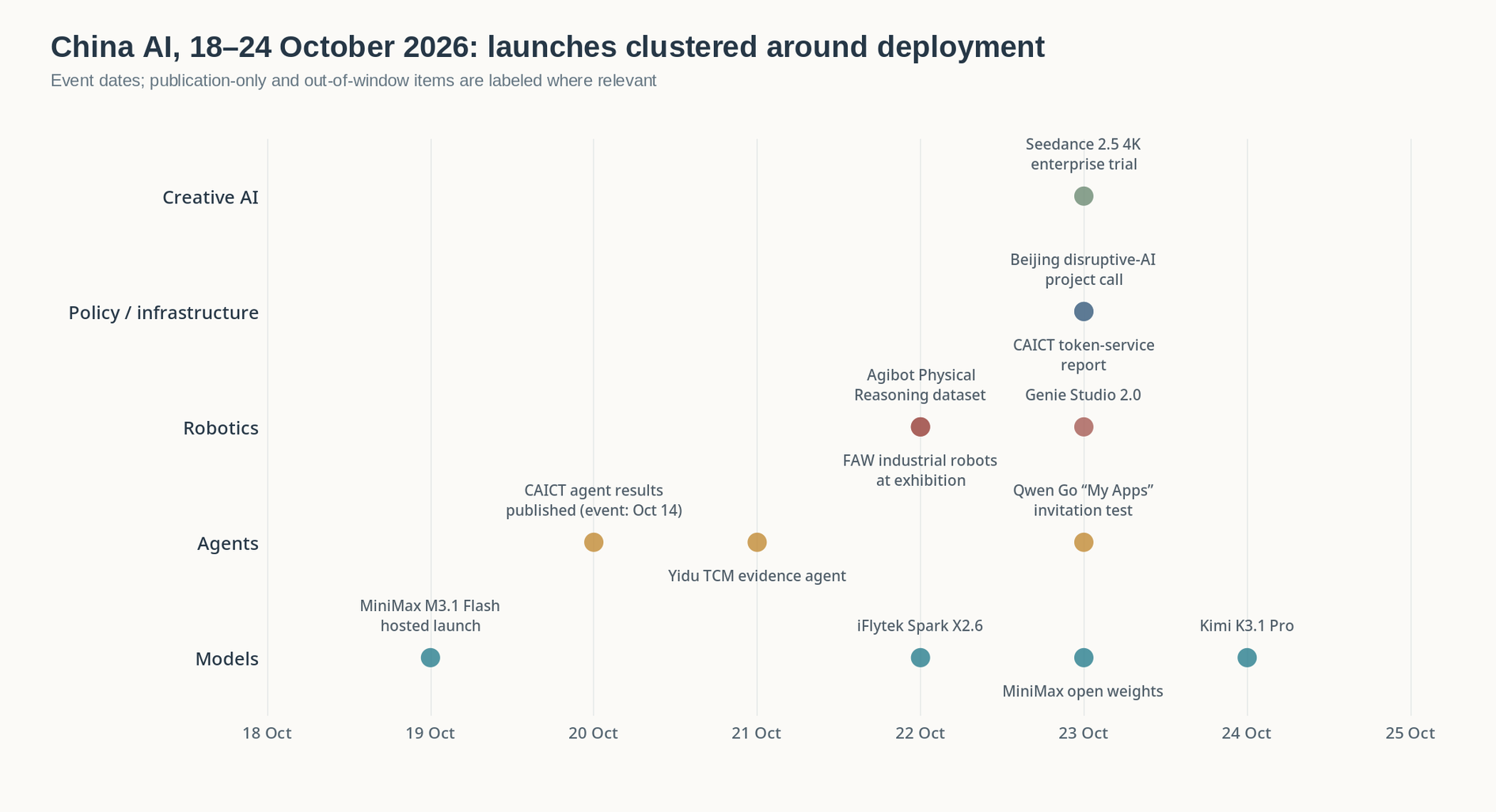
Figure 1. Event timeline compiled from the primary and Chinese sources linked throughout this report. The CAICT agent publication is explicitly distinguished from its 14 October event.
Five Developments Most Worth BunCosmos Following
Rank | Development | Why it deserves attention | Best next reporting step |
|---|---|---|---|
1 | MiniMax M3.1 Flash | Rare combination of hosted launch, actual weight release, low task cost, independent evaluation and a significant reliability caveat | Reproduce AA-Omniscience and agent tasks using the official weights; test whether retrieval or verification changes calibration |
2 | Kimi K3.1 Pro | Broad agentic and 3D ambitions, a 1M context and a forthcoming weight release make it strategically important beyond one benchmark table | Archive the promised license and weights on release; independently test long-horizon coding, 3D output and real task cost |
3 | Qwen Go “My Apps” | Persistent data, deployment and authorized personal-data connectors move consumer agents toward durable software rather than disposable prototypes | Test data persistence, permissions, export, deletion, multi-user behavior and failure recovery with invited accounts |
4 | Agibot Physical Reasoning dataset | Decision-state annotations address a genuine embodied-AI research bottleneck and include a path from high-level reasoning to low-level action | Inspect episode composition and annotation quality; establish baseline generalization results on unseen states and tasks |
5 | CAICT token-service monitoring | It reveals price, throughput, latency and provider-dispersion effects that per-token launch prices hide | Reproduce cross-provider measurements for identical models at matched context lengths and request loads |
The ranking is editorial rather than a claim of technical superiority. MiniMax ranks first because a researcher can already examine both independent measurements and downloadable artifacts, while Kimi’s most consequential openness question remains pending. Qwen Go ranks above larger conventional announcements because persistence and authorized data access could change what consumer agents are for. Agibot and CAICT complete the list because they supply reusable research infrastructure and deployment evidence, respectively. Seedance 2.5 4K narrowly misses the top five: its Draft-to-4K workflow is important for creative production, but the restricted trial and absence of independent quality comparisons limit what can responsibly be concluded now.
1. Model Launches and Major Updates
1.1 MiniMax M3.1 Flash: low-cost agents meet a calibration problem
MiniMax rolled out M3.1 Flash through its API, M Plan and MiniMax Code on 19 October, then published the weights on 23 October. The model card describes a native multimodal mixture-of-experts system with approximately 428 billion total parameters and 23 billion activated per token, text, image and video inputs, text output, and a context window of up to one million tokens. It uses sparse attention throughout, quantization-aware training and DSpark speculative decoding. MiniMax prices the hosted model at $0.15 per million input tokens, $0.60 per million output tokens and $0.015 per million cached input tokens (MiniMax launch, model card). Chinese reporting on 23 October concentrated on the open-weight release and the company’s speed and cost claims (Sina Finance).
The strongest independent evidence is mixed rather than simply celebratory. Artificial Analysis assigned the model an Intelligence Index score of 42, up from 29 for M3, while estimated cost per index task fell from approximately $0.51 to $0.22. On AA-Omniscience, it answered 56% of questions correctly, yet received a 93% hallucination rate under that benchmark’s conditional definition and an overall score of 16. The 93% figure does not mean that 93% of all answers were wrong: it measures the share of non-correct responses that were outright incorrect rather than refusals or partial answers. In practical terms, the model often attempted an answer when it should have acknowledged uncertainty (VentureBeat). That distinction is essential for accurate translation and headline writing.
MiniMax’s own benchmark table reports 62.8 on Automation-Bench v1.0.6, 76.2 on BankerToolBench, 73.7% on DeepSWE v1.1, 61.7 on OSWorld 2.0 and 82.2 on CyberGym. These remain vendor results, and the evaluation notes reveal different harnesses, context limits, judge models and data subsets. For example, Terminal-Bench used Codex 0.149.1, BankerToolBench used MiniMax-M2.7 as judge, and HLE was restricted to 2,158 text-only questions. The table is useful for forming hypotheses, but it is not a single controlled independent leaderboard (MiniMax model card). Claims of nearly three times faster inference and 70% lower agent-task cost likewise describe the company’s comparison with its predecessor, not a universal production result.
The weight release is genuine, but “open” needs qualification. The MiniMax Community License permits non-commercial use and allows commercial use with attribution and notification; products or services generating more than $20 million in annual revenue require separate prior written authorization from MiniMax. Commercial use is defined broadly enough to include paid products, commercial APIs and modified deployments (license text). This is materially different from MIT or Apache licensing. For BunCosmos, the publication-worthy angle is therefore not merely “a powerful cheap Chinese model,” but the three-way tension between agent economics, factual calibration and conditional openness.
1.2 Kimi K3.1 Pro: a broad agent launch whose open-weight test is still ahead
Moonshot introduced Kimi K3.1 Pro as the first model in its K3.1 series and its most capable 3T-class model to date, with a one-million-token context window. The company says it is a post-trained version of K3 using substantially more post-training compute and large-scale joint reinforcement learning across hundreds of downstream domains. It launched in Kimi.com, Kimi Work, Kimi Code and the Kimi API, alongside a Highspeed variant advertised at two to three times the standard model’s speed. Moonshot also made 3D Make available for creating, editing and exporting 3D assets (Moonshot AI). Chinese reports appeared on 24 October, while UTC-oriented English coverage recorded the announcement on 23 October (Sina Finance, ITHome).
Moonshot reports 65.7% on Terminal-Bench 4.0, narrowly below Claude Opus 5.5 at 66.4% in its table, and 61.2% on Kimi Code Bench 3.0 Long-horizon, compared with 55.95% for K3. It also reports 92.7% with tools on BenchCAD and presents examples involving games, Three.js scenes, CAD generation and a human-walking simulator. These are company-run evaluations and demonstrations. The Terminal-Bench result uses a public benchmark, but Moonshot’s own execution still needs reproduction; Kimi Code Bench is explicitly internal. The launch page itself notes that models were run at maximum thinking effort and that some comparison systems may include fallbacks or guards, making token use and task cost important missing variables (Moonshot AI).
The central verification point is temporal: K3.1 Pro was hosted and callable during this week, but its full weights were not yet released. Moonshot promised them by 4 November. It would therefore be premature to call the model independently reproducible or to assume the eventual license, architecture details and active-parameter count from K3. The date discrepancy is best handled transparently rather than “corrected” to one day: 23 October refers to the UTC announcement, while 24 October is the dominant Chinese publication date. For researchers, the most valuable follow-up is a post-weight-release evaluation covering long-horizon task success, output-token consumption, 3D asset usability and license terms.
1.3 iFlytek Spark X2.6: domestic compute and cloud–device routing
iFlytek released Spark X2.6 at its Global 1024 Developer Festival on 22 October, presenting it as an integrated cloud–device system with an X2.6-4B endpoint model. The company says the release achieved coding and agent advances using fully domestic compute. It also described dynamic parallel training for long tasks, adaptive storage–compute inference, four-layer KV caching on domestic equipment, and routing among local execution, cloud collaboration and cloud-only processing according to task difficulty, device capability and data sensitivity (Beijing News, Sina Finance). The architectural story is more specific than a generic “on-device AI” announcement because privacy and cost depend on where each part of a task runs.
The reported numbers require restraint. iFlytek cited approximately 4× higher long-context training efficiency and 4.5× higher inference efficiency, while other launch coverage reported 96.1% routing accuracy and 41.9% device-model coverage of agent tasks. These figures were presented by the company and no independent evaluation was found in the searched sources. Chairman Liu Qingfeng’s projection that 60% of applications could be completed locally, 30% through cloud collaboration and 10% by cloud models is a strategic forecast, not a measured distribution of current workloads (Beijing News). A useful investigation would measure routing accuracy by task class, redaction failures, end-to-end latency and energy use on named domestic chips.
2. Chinese AI Agents and Agent Platforms
2.1 Qwen Go “My Apps”: persistent applications rather than disposable demos
Alibaba’s Qwen Go introduced “My Apps” on 23 October, allowing users to describe an application in natural language for scenarios such as education, health, fitness, activities and personal organization. The feature connects to Alibaba Cloud’s Meoo application-production platform, which handles application construction, database configuration, deployment, storage and sharing. China Economic Net’s report explicitly distinguishes these apps from one-off generated tools: they can retain data over time, support continuing updates and be used by multiple people. Examples include interactive courseware, activity registration, family travel guides and fitness-class booking (China Economic Net). This makes the development architecturally more consequential than a chatbot producing a single HTML page.
The accompanying Cloud Pro capability can, after user authorization, draw on personal data from services including Taobao, Damai, Amap and Quark. That creates a possible bridge between Alibaba’s consumer-data ecosystem and user-generated software: a generated app could organize previous purchases, performances, travel or study records rather than starting with an empty prompt. However, both “My Apps” and Cloud Pro were in invitation testing, with users required to apply for access. The report provides product examples, not independent evidence about permission boundaries, data deletion, security, generated-code quality or failure recovery (China Economic Net). Those questions should frame any hands-on review.
For BunCosmos, the important analytical shift is from “agent as assistant” to “agent as software producer and operator.” Persistence changes evaluation criteria: a visually impressive first generation is insufficient if database migrations break, shared users see one another’s data, or an update destroys stored state. A publication-worthy test would build the same multi-user application across several platforms, then examine persistence, permission prompts, exportability, versioning, data deletion and total cost after a week of real use. English-language searches produced no contemporaneous coverage of this feature, making it one of the clearest reporting gaps of the week.
2.2 CAICT’s agent evaluation: useful standardization, but not a ranking
CAICT published an updated trusted-AI agent evaluation page on 20 October, although the underlying results were presented at the AIIC agent forum in Jinan on 14 October. The page says CAICT has served more than 70 organizations and lists 74 evaluated products or product evaluations cumulatively across platform tools, technical capability, memory, application services, general applications, industry applications and maturity. The newest named participants include Midu, Xianniu, Shanghai Cyclone, CETC, Nanjing NARI, State Grid Fujian, Southwestern University of Finance and Economics, and Chongqing Cyclone Longcheng (CAICT). Because the event predates the strict window, this is an in-window publication rather than a new 20 October certification ceremony.
The evaluation is relevant because Chinese agent procurement is developing formal categories beyond generic model benchmarks, including memory, business value and application maturity. It should nevertheless not be described as a leaderboard. Passing an assessment does not mean ranking first, and the cumulative 74 entries must not be rewritten as “74 newly certified products this week.” The public page also does not provide enough task-level scoring to reproduce comparisons among Alibaba, Baidu, Tencent, iFlytek and other listed platforms. A stronger follow-up would request the evaluation specifications and test sets, then compare whether “maturity” and “business value” correlate with independently observed deployment outcomes.
3. Robotics and Embodied AI
3.1 Agibot Physical Reasoning: decision-focused real-robot data
Agibot open-sourced the fourth release of AGIBOT WORLD 2026 on 22 October, calling it a Physical Reasoning dataset. The official announcement says task design shifts from manipulation difficulty to decision-making complexity: the same goal is represented under different states and constraints, with high-level question answering and low-level robot trajectories connecting decisions to physical execution. Examples include choosing items according to a weather forecast, counting full and empty bottles before restocking a minibar, and remembering which drawers have already been searched. The release is intended to support coordinated training of high-level decision models and low-level action policies (Agibot, Shanghai Observer via Sina).
Chinese reporting describes nine categories of reasoning, Easy/Medium/Hard levels, and annotations for task instructions, stages, subtasks, actions, spatial targets and outcomes. The annotations are potentially valuable because they make task progress and decision rationale available alongside motion, rather than treating every trajectory as an isolated imitation-learning example. The repository states that all data and code are under CC BY-NC-SA 4.0, meaning the resource is non-commercial and share-alike rather than unrestricted for commercial training pipelines (dataset repository). That licensing fact deserves more prominence than the broad word “open-source” usually receives.
The release does not demonstrate that robots can reason reliably in unseen homes or workplaces. It supplies training and evaluation material; generalization still needs to be measured with held-out tasks, environments and initial states. Agibot’s framing of dataset firsts should also be treated as a company claim unless a systematic comparison with prior embodied reasoning datasets is performed. The most useful research question is whether decision–execution co-training on this release improves recovery from changed quantities, blocked paths, partial observability and interrupted tasks, rather than merely increasing success on trajectories similar to the training distribution.
3.2 Genie Studio 2.0: the operations layer behind robot deployment
On 23 October, Agibot released Genie Studio 2.0, a workflow platform divided into Flywheel, Agent and Monitor. Flywheel covers data collection, model training, simulation, real-machine deployment and feedback of abnormal data; Agent provides visual composition of navigation, visual positioning and inference into work processes; Monitor manages status, task progress, alerts and remote intervention across multiple robots. The company says a new scenario can be validated in as little as seven days, positioning the platform as the connection between model capability and sustained operations (Shanghai Securities News via Sina). This is a different contribution from a new VLA model: it addresses integration, orchestration, observability and maintenance.
Reported cases include 14 days from requirements to production-line implementation for CNC machine loading, 99.9% task success and a cycle time below 13 seconds in a BMS assembly project, multi-robot operations at Longcheer, and more than 60 devices in a Guangzhou Metro service setting. All are company or launch-report figures, with no independent audit of denominators, intervention rates, test duration or failure severity. The seven-day claim should therefore be read as a fastest-case deployment-validation statement, not an average full-production rollout time. Future AI WAVE announcements scheduled for 26–30 October are not counted as releases in this report.
3.3 FAW: industrial VLA demonstrations with explicit validation limits
FAW displayed several robot systems during the 21–24 October China International New Energy and Intelligent Connected Vehicle Exhibition, with Xinhua publishing on 22 October. Its heavy-load robot is intended for automotive material handling, with a rated dual-arm load of 50 kg and a stated maximum of 80 kg. The report says the system remains in test validation. FAW’s upgraded wheel-arm robot moved from single-hand grasping to synchronized two-hand operation and combines a self-developed VLA operation model with whole-body control (Xinhua). The distinction between rated load, maximum load and validated production load should be preserved in any English summary.
The wheel-arm system was reportedly validated on real automotive workstations for bottle sorting, bin handling, palletizing and loading. That is more meaningful than a stage-only demonstration, but the article supplies no independent success rate, uptime, cycle-time distribution, safety case or number of deployed units. “Validated on workstations” should not be expanded into “mass deployed across FAW factories.” The story is nevertheless worth watching because automotive manufacturers provide structured environments, existing quality systems and repetitive material-handling tasks where embodied AI can be evaluated against conventional automation.
4. Policy, R&D and Deployment Infrastructure
4.1 Beijing’s disruptive-AI call: specific technical directions, not new regulation
Beijing’s science and technology authorities opened a call for disruptive-AI reserve projects on 23 October, with applications closing at 18:00 on 2 November. The three directions are AI-native or disruptive chips; non-Transformer and biologically inspired algorithms, including state-space approaches and architecture–low-bit co-design; and frontier models with recursive self-improvement, adaptive architectures, continual learning, long-context reasoning and native multimodality. Chip projects must complete application validation with at least two real user organizations, while algorithm projects must validate a new architecture at no less than 10 billion parameters. Enterprise applicants must provide matching funds at a ratio of at least 2:1 relative to government science and technology funding (Beijing Municipal Science & Technology Commission).
This is best classified as an R&D funding call, not AI regulation. Its significance lies in the specificity of the technical bottlenecks and the demand for real-user validation, reusable toolchains and industry testing. It reveals which alternatives to prevailing architectures local policymakers consider worthy of support, but it does not show that any resulting technology already works. No comparably significant new national AI regulation was verified within the 18–24 October window. Separately, a Shenzhen AI and application action plan circulated with a 23 October page date, but the original municipal document was issued on 4 September; treating the repost as a new October policy would be recycled news (Shenzhen original).
4.2 CAICT token-service monitoring: a more complicated inference economy
CAICT published a token-service monitoring report on 23 October, covering January–August 2026. It reported daily domestic token consumption of around 500 trillion in June, nearly four times the December 2025 level. More useful for current analysis are its cross-service measurements: the normalized domestic average price rose from RMB 6.8 in the second half of 2025 to RMB 13.46 in 2026, while the comparable foreign average was about RMB 117.8. Domestic August output speed averaged 78.23 TPS, compared with 38.25 in 2025 and 112.82 for monitored foreign services. Domestic average time to first token increased from 0.78 to 1.26 seconds, while the foreign August average was 2.08 seconds (CAICT).
The report also found that 95.7% of monitored models offered at least 200K context and 47.8% offered 1M context. Performance for the same model varied materially across providers, with TPS gaps approaching twofold. These findings undermine three simplistic comparisons: that list price equals task cost, that the same model delivers the same service everywhere, and that longer context automatically improves user experience. Rising normalized prices can coexist with falling prices for particular models because model mix, reasoning length and normalization methods matter; similarly, faster output does not prevent slower initial response (CAICT).
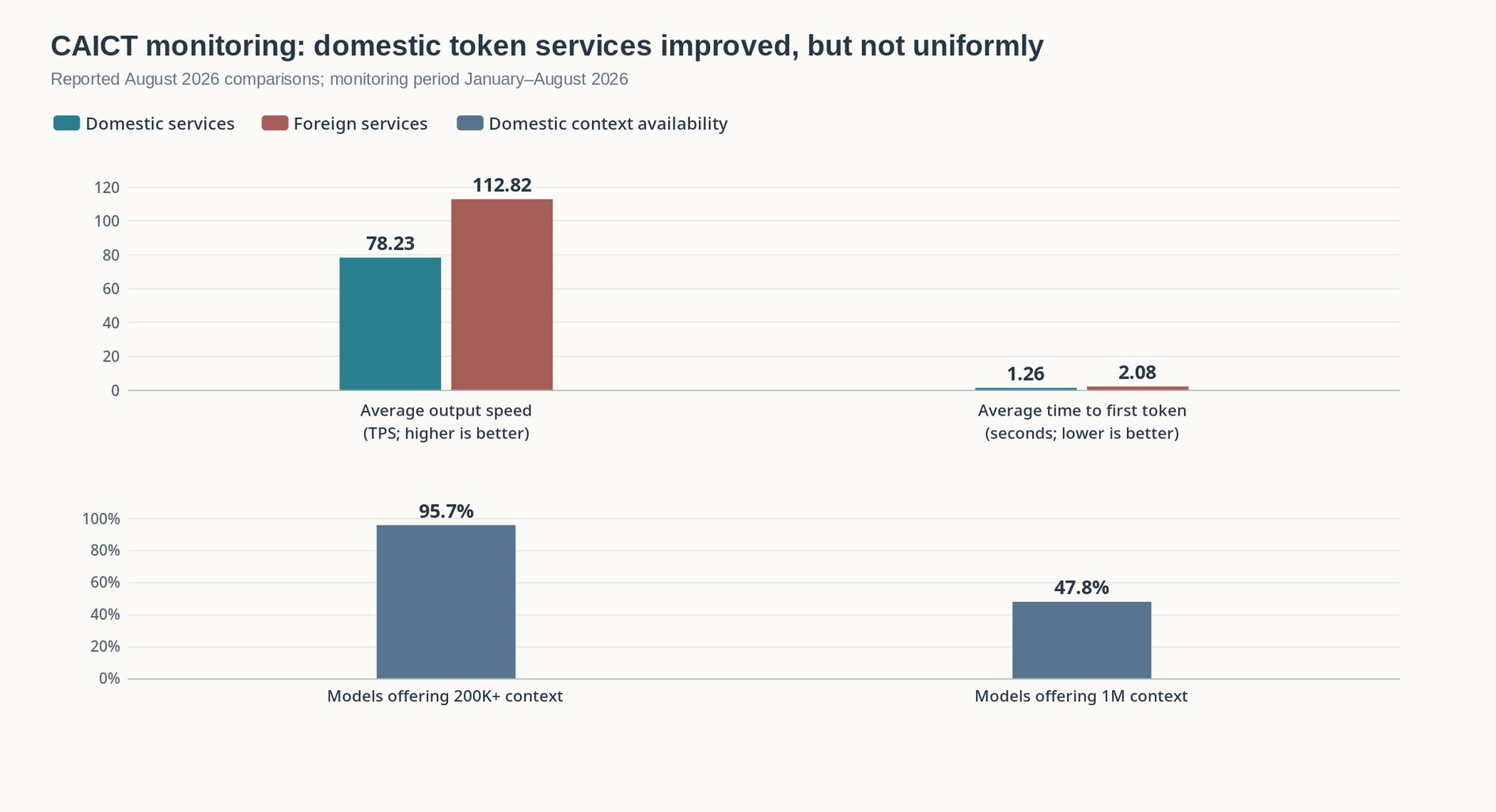
Figure 2. CAICT-reported August 2026 service metrics and domestic context availability. TPS and TTFT are shown in separate labeled columns because their units and desirable directions differ. Source: CAICT.
The 500-trillion-token figure had already attracted attention before this report, so it should not be marketed as a wholly new 23 October measurement. The report’s stronger contribution is the joint view of price, speed, latency, context and provider dispersion. For BunCosmos, a natural follow-up is to test identical open-weight models across Chinese and international inference providers at fixed reasoning settings, prompt lengths and concurrency, recording success rate and total tokens as well as advertised prices.
5. Research Papers and Scientific Uses of AI
5.1 No dominant peer-reviewed Chinese AI paper was verified in the exact window
Searches did not establish a single major peer-reviewed Chinese AI paper released during 18–24 October that belonged alongside the week’s model and platform launches. That is a reporting result, not a claim that no Chinese researchers published anything. Conference pages, laboratory announcements and older papers frequently appeared because search engines rewarded recency or popularity rather than the requested event window. Elevating one of them merely to fill a “paper of the week” slot would create a false impression of significance. The more defensible conclusion is that applied scientific systems produced clearer in-window developments than a landmark paper.
This absence should also be distinguished from the importance of Agibot’s dataset. A repository release can be scientifically useful without a new peer-reviewed paper, but its research value depends on documentation, task composition, license, baselines and independent use. Researchers looking for publication topics may find more opportunity in evaluating such artifacts than in summarizing launch claims. The same applies to MiniMax’s released weights: independent calibration and agent-harness studies can produce new evidence that did not exist in the launch materials.
5.2 National Energy Group: an applied catalyst-research case, published after the event
National Energy Group published an account on 23 October of an AI-assisted catalyst research platform, although the associated award event occurred on 15 October, outside the strict window. The organization described local literature bases of 12,000 and 1,500 papers in different catalyst workflows, more than 5,000 structured preparation parameters, and a knowledge graph containing more than 27,000 entities and 62,000 relationships. It also connected the system to automated laboratory operation and claimed an approximately 70% reduction in formulation research and screening time (National Energy Group). This is an operational case study rather than a peer-reviewed scientific validation.
The claimed time saving needs a denominator and baseline: which projects, which stages, how much human review, and whether the resulting formulations met the same performance criteria. Nevertheless, the combination of literature extraction, structured preparation parameters, knowledge graphs and automated experiments is more substantive than a generic “AI for chemistry” chatbot. A follow-up should seek a technical paper, experimental protocol, baseline cycle time and examples of experimentally confirmed catalyst improvements before treating the productivity figure as established.
5.3 Yidu Tech’s TCM evidence agent: traceability without clinical validation
Yidu Tech introduced the “Xiaohuangqi” traditional Chinese medicine evidence agent on 21 October. Reported functions include retrieval from classical texts, tracing guidelines, syndrome-differentiation support, prescription lookup and terminology translation. The product framing emphasizes evidence provenance, which is appropriate for a domain where generated text can otherwise obscure whether a statement came from a classical source, a modern guideline or the model itself (Tencent News). Knowledge-base scale and deployment across roughly 40 hospitals were reported by the company or launch coverage rather than independently audited.
No clinical-outcome evaluation was found, so the system should not be described as improving diagnosis or treatment. The researchable questions are narrower and still valuable: whether citations resolve to the correct passage, whether contradictory schools or guidelines are represented, how uncertainty is displayed, and whether clinicians can distinguish retrieval from generation. Any publication should include professional review and avoid converting evidence-tracing functionality into a claim of medical efficacy.
6. Creative AI: Image, Video and 3D Generation
6.1 Seedance 2.5 4K: a production workflow, with restricted access
Volcengine released Seedance 2.5 4K on 23 October. Its Draft mode lets users generate 480p previews to test storyboards and iterate on shots before producing a 4K final. The model supports 10-bit color, and Volcengine claims better preservation of source-image quality, clarity and color consistency during reference generation and editing. The official material reproduced by Phoenix Tech says this version received specialized training for facial expressions, subtle motion and image detail (Phoenix Tech, Volcengine documentation). The workflow is significant because high-resolution generation can be expensive; previewing composition before final rendering addresses cost and iteration, not just pixel count.
Access was limited to some enterprise customers, with possible expansion later. Customer comments about lighting, optical perspective and depth of field are testimonials, not controlled comparisons. English search results also mixed this release with older Seedance 2.5 availability, so the accurate weekly story is the new 4K variant and Draft workflow, not the invention of the entire Seedance 2.5 family on 23 October. Claims that it is the “strongest” model in its generation remain vendor language until independent blind evaluations test temporal consistency, editing fidelity, color, motion and failure rates.
6.2 Kimi’s 3D Make: creative AI inside an agent workflow
Kimi’s launch added a different creative-AI signal: 3D Make is integrated into the same product environment as coding and agentic tools. Moonshot says K3.1 Pro can work with Blender and CAD scripts, use asset libraries, generate parametric models, and export models for printing or sharing. It reports 92.7% with tools on BenchCAD, behind Claude Opus 5.5 and GPT-6 Astra in its own comparison (Moonshot AI). Unlike a text-to-image launch, the emphasis is on editable artifacts and tool-mediated creation.
The demonstrations do not establish mesh quality, print success, editability across software, license provenance of reused assets or consistency over long projects. Those are precisely the questions a creative-technology reviewer can test. Comparing Seedance and Kimi also shows why “creative AI” should not be reduced to visual spectacle: ByteDance’s news concerns a film-production iteration pipeline, while Moonshot’s concerns agent-generated, manipulable 3D assets. Both deserve task-based evaluations rather than cherry-picked showcase outputs.
7. Named-Company Coverage Ledger
Organization | Verified status in the 18–24 Oct window | Editorial treatment |
|---|---|---|
Moonshot / Kimi | K3.1 Pro hosted launch and 3D Make; weights promised by 4 Nov (official) | Major story; do not describe weights as already public |
MiniMax | M3.1 Flash hosted launch on 19 Oct and weights on 23 Oct (official) | Major story with independent reliability evidence and license conditions |
Alibaba / Qwen | Qwen Go “My Apps” invitation test on 23 Oct (Chinese report) | Major agent-platform story; availability must be qualified |
ByteDance / Volcengine | Seedance 2.5 4K selected-enterprise trial on 23 Oct (Chinese report) | Important creative workflow; not general availability |
DeepSeek | V4.1-Flash-1017 was released on 17 Oct; an in-window financing/IPO story remained unconfirmed | Use the model only as context; exclude unconfirmed financing as fact |
Tencent | No comparably significant new model launch verified; Yidu report appears on Tencent News but is not a Tencent model release | Do not convert platform distribution into corporate development |
Baidu | No major in-window launch verified; appears in CAICT’s cumulative evaluation list (CAICT) | Evaluation listing is not a new Baidu release |
Zhipu | No major in-window launch verified; appears as a comparator in vendor tables and CAICT’s cumulative list | Avoid recycling older GLM releases |
Kuaishou / Kling | Kling 4.0 was outside the window; no precise in-window full-release event verified | Exclude rather than backfill with late-September news |
iFlytek | Spark X2.6 cloud–device launch on 22 Oct (Beijing News) | Significant domestic-compute and routing story; vendor metrics only |
Agibot | Physical Reasoning dataset on 22 Oct and Genie Studio 2.0 on 23 Oct (dataset) | Two distinct embodied-AI stories; future AI WAVE items excluded |
FAW | Industrial robots shown during 21–24 Oct exhibition (Xinhua) | Validation-stage industrial case, not mass-deployment proof |
This ledger is intentionally conservative. The absence of a verified launch does not imply inactivity; it means the searched evidence did not meet the window and significance thresholds. It also prevents vendor benchmark tables from becoming a substitute for current news: DeepSeek and GLM appear frequently as comparators in Kimi and MiniMax materials, but that does not make their older releases new developments this week. Likewise, CAICT’s cumulative evaluation list is useful evidence of ecosystem breadth, not a set of fresh announcements by every company named.
For emerging laboratories and application companies, the strongest verified items were MiniMax, Agibot and Yidu. Other possible leads lacked either reliable dating, primary documentation or enough technical substance to justify inclusion. This conservative approach is particularly important around financing rumors and anonymous-model speculation. Space Bunny is included only because MiniMax itself identified it as an earlier M3.1 Flash version; unconfirmed model identities and DeepSeek financing claims are not treated as established events (MiniMax).
8. Source Comparison and Reporting-Risk Log
Risk | Chinese-language pattern | English-language pattern | Reliable editorial handling |
|---|---|---|---|
MiniMax reliability | Launch reports emphasized speed, price, open weights and agent capability | VentureBeat foregrounded Artificial Analysis’s capability gains and hallucination behavior (VentureBeat) | Report both; explain that 93% is conditional on non-correct responses, not the share of all answers wrong |
Kimi date | Chinese reports dated the launch 24 Oct (ITHome) | UTC-oriented coverage recorded 23 Oct | State “23 Oct UTC / 24 Oct China” and preserve the official blog link |
Openness | “开源” and “open” often used broadly in launch summaries | Licensing specialists distinguished open weights from permissive open source | Quote the actual MiniMax Community License and Agibot CC BY-NC-SA terms |
Availability | “上线” and “发布” can headline a feature before access is broad | Aggregators may repeat the launch without the invitation restriction | Qwen Go = invitation test; Seedance 4K = selected enterprise trial; Kimi weights = promised |
Robotics evidence | Customer cases and demonstrations may be described as “landing” or “deployment” | English robotics analysis may focus on dataset scale and licensing | Separate data release, workstation validation, fastest deployment case and scaled operations |
Policy timing | Government republications can carry a new page date | Search snippets often preserve only the latest date | Trace to the original issuing page; Shenzhen’s plan dates to 4 Sep, not 23 Oct |
CAICT statistics | Large token-consumption numbers make attractive headlines | International coverage may repeat them without monitoring context | Emphasize the report’s new cross-provider price, latency and throughput analysis |
Benchmark provenance | Vendor tables may be quoted as neutral rankings | Secondary sites may mix harnesses and model versions | Label every score as vendor-reported unless an independent run is identified |
The most consequential bilingual discrepancy concerns MiniMax. Chinese reports supplied the domestic launch and open-weight context, while English coverage added an independent evaluation that changes the practical interpretation of the model. Neither side is sufficient alone: a report using only Chinese launch material would miss calibration risk, while one using only the hallucination headline would miss the actual weight release, license conditions, multimodal input and serving architecture. A strong article should integrate the primary model card, license, Chinese reporting and independent testing rather than translating any single account.
The largest coverage gaps are not necessarily evidence of editorial bias. Some Chinese releases were available mainly through domestic media, WeChat-derived reports or invitation-only product surfaces, making them harder for English outlets to discover and test. Search indexing also favors large model names over government R&D calls and industrial software. Nevertheless, the effect is systematic: English-speaking readers see frontier-model competition more clearly than the application persistence, robot operations, domestic-compute routing and inference-service measurement that occupied much of the Chinese coverage.
9. Publication-Worthy Research Agenda
Proposed investigation | Why the current evidence is insufficient | Minimum useful test or document |
|---|---|---|
MiniMax calibration under agentic tool use | AA-Omniscience measures factual behavior, not every agent workflow | Official-weight runs with matched effort; abstention, retrieval and verifier conditions; task-cost accounting |
Kimi long-horizon coding and 3D usability | Launch benchmarks and demos are vendor-run; weights are pending | Independent repository tasks, token/latency logs, mesh and print-quality rubric, post-release license review |
Persistent app generation in Qwen Go | Invitation examples do not establish data safety or durability | Multi-user app with CRUD operations, updates, export, deletion, permission revocation and failure injection |
Agibot decision–action learning | Dataset existence does not prove generalization | Held-out states and environments; high-level-only, low-level-only and co-trained baselines |
Cross-provider inference dispersion | CAICT reports substantial variation but launch prices hide task economics | Same model, quantization, context and concurrency across providers; success, TTFT, TPS and total tokens |
Cloud–device routing on domestic compute | iFlytek’s accuracy and efficiency figures are vendor-reported | Named hardware, task-stratified routing confusion matrix, privacy failures, latency and energy measurements |
Genie Studio deployment claims | Fastest-case and customer metrics lack denominators | Intervention rate, uptime, failure taxonomy, deployment-team hours and comparison with conventional integration |
Seedance Draft-to-4K production economics | Quality claims and customer testimonials are not controlled evidence | Blind pairwise evaluation plus cost and iteration-time comparison against direct high-resolution generation |
Evidence-tracing medical agents | Retrieval features do not establish clinical benefit | Citation correctness, source coverage, clinician review and explicit separation from outcome claims |
These investigations share a methodological principle: measure the system at the layer where the announcement claims progress. A model with a low per-token price should be evaluated on cost per successful task; an app generator should be evaluated on durable state and permissions; a robot dataset should be evaluated on generalization; an operations platform should be evaluated on interventions and uptime; and a creative model should be evaluated on iteration cost and artifact usability. This approach would produce new evidence rather than another comparative summary of vendor tables.
Researchers should also preserve artifacts and versions. The week included hosted launches, repository releases and limited trials that can change quickly. Model hashes, API dates, reasoning settings, prompt sets, license snapshots and invitation dates should be recorded with results. Without those details, later reproduction may accidentally compare a different model, a different quantization or a different product tier. The same discipline applies to translation: retain the original Chinese availability term and the event date alongside the English summary.
What Western AI Coverage May Be Missing
Qwen Go’s persistent application infrastructure. Western coverage of consumer agents often concentrates on chat quality, browser operation or one-shot app generation. Qwen Go’s in-window development is different because Meoo supplies database configuration, deployment, storage and sharing, while authorized connectors can draw on existing personal data from Alibaba services. The story is not that a Chinese chatbot can make a pretty page; it is that a consumer platform is testing durable, multi-user software with a data ecosystem behind it. English searches returned no contemporaneous coverage, perhaps because the feature was invitation-only and documented mainly in Chinese. The crucial follow-up is governance: export, deletion, permissions and update safety will determine whether this is a meaningful new application layer (China Economic Net).
iFlytek’s domestic-compute cloud–device architecture. Spark X2.6 received little substantive English coverage beyond encyclopedic or launch-summary material. Yet the technically interesting questions concern how tasks are divided between a 4B local model and cloud systems, how local redaction interacts with cloud escalation, and what fully domestic training and inference require in memory, bandwidth and caching. This is both an AI-systems story and a compute-sovereignty story. Western reports that mention only “another Chinese LLM” would miss the routing and privacy architecture, while Chinese reports that repeat the efficiency figures without independent tests miss the evidence gap (Beijing News).
CAICT’s evidence against a simple price-war narrative. International discussion of Chinese inference often centers on extremely low per-token prices. CAICT’s monitoring adds that normalized domestic average prices rose, TTFT worsened even as TPS improved, and identical models can perform very differently across providers. It also documents rapid diffusion of 200K and 1M context offerings. The 500-trillion-token headline is easier to translate than these operational nuances, but the latter are more useful to enterprises choosing a provider. A Western article focused only on MiniMax’s $0.15/$0.60 rates would miss the serving-layer variables that determine real task cost and user experience (CAICT).
Agibot’s operations layer and the limits of “open” robotics. English robotics coverage can recognize a large dataset more readily than a deployment platform. Genie Studio 2.0’s Flywheel, Agent and Monitor modules show that the practical competition includes feedback loops, workflow orchestration, alerts and remote intervention across fleets. At the same time, the Physical Reasoning dataset’s CC BY-NC-SA license limits commercial use, and neither the dataset nor the platform’s customer claims prove generalized autonomy. A balanced account should connect the research artifact to the operations stack while preserving those evidential limits (Agibot dataset, Genie Studio report).
Beijing’s highly specific alternative-architecture agenda. The 23 October call explicitly supports non-Transformer architectures, state-space models, low-bit co-design, recursive self-improvement, continual learning and AI-native chips, with real-user validation requirements. This is more revealing than a broad statement that China is “investing in AI.” It indicates which technical uncertainties public R&D programs want to resolve and how they expect projects to demonstrate usefulness. The absence of English coverage may reflect the document’s local and administrative nature, but researchers tracking post-Transformer architectures and compute policy should read it directly (Beijing Municipal Science & Technology Commission).
Industrial validation at FAW and evidence-tracing vertical agents. FAW’s robots matter less as humanoid spectacle than as tests inside automotive workflows, with explicit limits: the heavy robot remains in validation and the wheel-arm system has workstation-level evidence rather than audited fleet metrics. Yidu’s TCM agent similarly matters for source tracing and terminology infrastructure, not for any demonstrated clinical benefit. Both stories are easy for Western coverage to miss because they are vertical, Chinese-language and light on dramatic benchmark claims. They are also easy to exaggerate; responsible reporting should preserve the difference between a demonstration, an operational case and independently measured outcomes (Xinhua, Tencent News).
This report is for general research and editorial information only. It does not constitute investment, legal, medical, or other professional advice.